
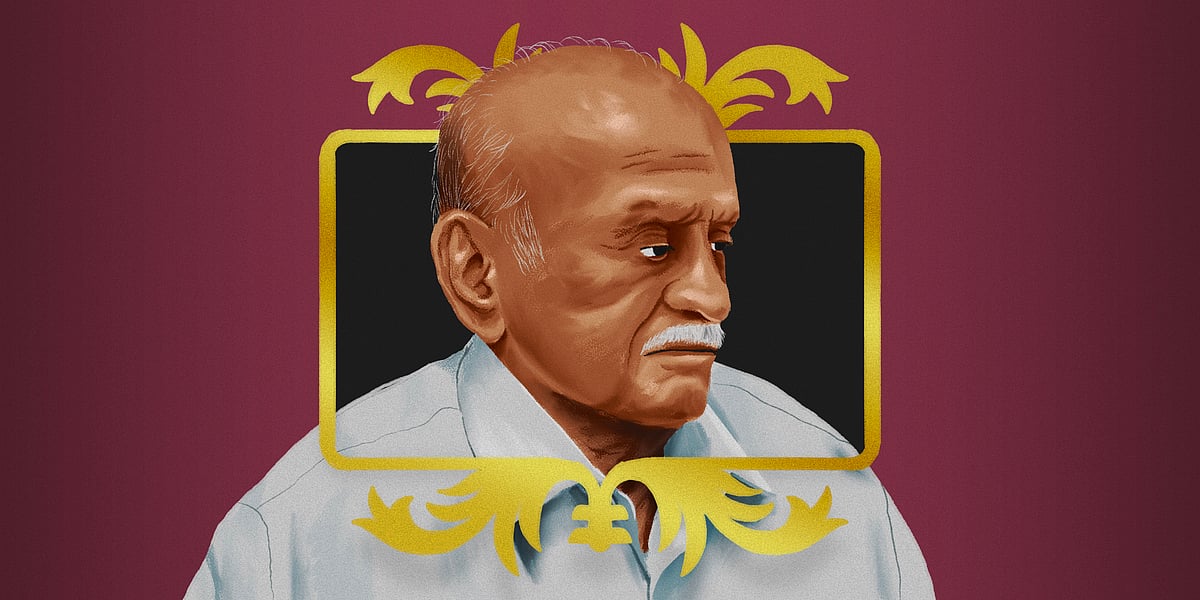
If you happen to be familiar with even some of the Kannada scholar M M Kalburgi’s output – his collected works round out to 27,000 pages and 68 kilograms – it might not surprise you that this piece begins from the 12th century and gets into a fair bit of mediaeval history. These historical times (and the troubles taken to recreate them) form the backdrop against which Kalburgi’s own life unfolded.

It has not been easy to pin a date on the mediaeval Sanskrit text known as the Srikara Bhashya, composed by an elusive figure named Sripati Pandita (and not somebody named Srikara, as I’d presumed). For our present purposes, we may see it as an evolving text of sometime around the 12th and 13th centuries CE, a theological response to the Vedanta school, one of the most prominent streams of Hindu philosophical thought. The Srikara Bhashya does not subscribe to the (illusory) non-dualism of Adi Shankara, perhaps Vedanta’s most famous exponent, and though these centuries witnessed a serious social gulf between worshippers of Shiva and Vishnu, the Shaiva theology of the Srikara Bhashya bears some similarity to the philosophy of the 11th-century Sri Vaishnavite saint Ramanuja. Both espouse a “qualified non-dualism” that seeks to separate the Self and the Godhead (Atman and Brahman) even as they suggest a potential union. The Srikara Bhashya evidences no engagement with the 12th-century Virashaiva (or Lingayat) leader Basavanna, and the references it carries to the 13th-century dualist theologian Madhva are most likely to be later additions. (The terms Virashaiva and Lingayat are often used interchangeably today, but they carry interpretive differences, which we will return to.)
The subsequent centuries in the Subcontinent witnessed a plurality of devotional renewals, with an increased emphasis on questioning entrenched social hierarchies. We commonly know this as the Bhakti Movement, though this phrase hardly captures the diversity of expressions (or geographies) clubbed under it. Not long after the Srikara Bhashya was composed, in the region of the Deccan presently called Kalyana-Karnataka, a transformative cohort of seekers (both men and women) known as the Sharanas reimagined the Shaiva tradition into a radical new idiom of democratised spirituality. We now know the Sharanas’ creations as the vachanas – a constantly evolving body of over 20,000 Kannada verses, animated by a remarkable diversity of voices. Basavanna is usually seen as the most vital rejuvenator of the Virashaiva tradition, a towering leader of the Sharanas, remembered for his staunch anti-Brahminical stance – a firm if gentle castigator, a leveller of hierarchies, a threat to power and pretension.