
The onslaught of television channels for the last two and a half decades seems to have redefined the very notion of leisure and entertainment in the average Indian household. Today most of the population is beholden to satellite television for their daily dose of amusement. However, the majority of the rural population in the state of Assam still remains engrossed in the art form of mobile theatre. Imagine people queuing up to buy theatre tickets at 5 am. It's not an illusion or some utopian situation, but a reality across the state from mid-August to 13 April every year.
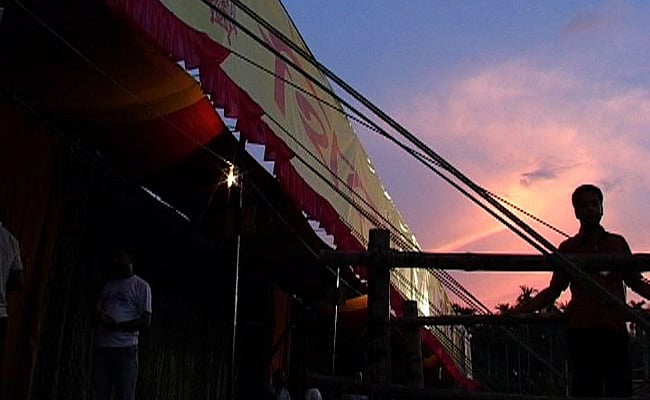
Assam, situated on India's northeast frontier, is home to this unique form of entertainment. The touring theatre groups visit towns and villages, carrying their own stage equipment, generators and even auditoriums in trucks. They pitch their tents in open spaces and erect makeshift auditoriums with seating capacities between 2000 and 2500. For quick changes of scene, two stages are erected. After rehearsing for about two months, each theatre troupe travels across the state to 70 pre-determined locations and performs for 210 consecutive nights, staging plays for three to four days in each place. Come winter, spring or early rain, nothing deters the local folk, and every year theatre aficionados pack the tents in droves, making mobile theatre the biggest entertainment industry in the entire Northeast and leaving mainstream cinema far behind.
The mobile theatres' source of income is completely restricted to ticket revenues, with prices ranging from INR 40 to 60 for gallery audiences and 100 to 200 for those in the front rows. Interestingly, mobile theatres donate 40 percent of their income to schools, colleges, village clubs, and other social and religious organisations, thus concurrently performing a social service. This arrangement is perhaps the only one of its kind in the world. Another unique feature of the mobile theatres is that the entire company – nearly 130 people, including the actors, directors, producers, technicians, cooks, helpers and even the drivers – travel and live together like a commune, performing their respective duties, coordinating their activities day in and day out for nine months and eventually sharing a common cultural space and identity. Self-reliance is the intrinsic rule of this art form.
Initially the mobile theatre repertoire was based purely on mythology and folklore. With the passage of time it has undergone an exceptional transformation, and today the uniqueness of mobile theatre dwells in the topicality and diversity of its themes. Mobile theatre embraces a range of contemporary material; this has included plays based on the royal palace massacre in Nepal, the attacks on the World Trade Center, the lives of Saddam Hussein, Benazir Bhutto and Lady Diana, and adaptations of James Cameron's Titanic and other Hollywood successes like The Lost World, Godzilla, and My Best Friend's Wedding. While tackling contemporary issues from around the world, over the last few years mobile theatre has received rave reviews in the international media, with dozens of foreign journalists and television crews trailing the travelling theatres through bad weather and muddy villages. In spite of the lack of state support or any other patronisation, mobile theatre has sustained itself as an alternative art form, coping with the changing times and adapting in order to stay relevant. Embracing modern technology to compete in a world of sleek media production, it has revamped and redefined global trends in a local context.