
(This is an analysis from our June 2014 print quarterly, 'Growing Media, Shrinking Spaces?'. See more from the issue here.)
As the last round of polling neared in India's general elections, dispirited workers of the Congress party seemed to spark momentarily to life. Hopelessly devoted to the dynastic principle – and fearful of exercising any manner of liberty not granted from the quarter referred to in hushed whispers as the 'high command' – volunteers in the cause of extending the Congress party's long lease on power responded with enthusiasm when the chosen standard bearer of the Nehru-Gandhi family, Rahul Gandhi, yielded some space to sister Priyanka on the campaign trail.
The rival Bharatiya Janata Party (BJP) seemed by then to be gathering an irresistible momentum towards victory, but was disinclined to take any risks. As reported in the media, the BJP prime ministerial candidate Narendra Modi, eight days ahead of the final round of polling, called up trusted aide Amit Shah, who was manning his campaign office in the city of Varanasi in Uttar Pradesh (UP). The quick confabulation yielded an immediate assessment and action plan: Priyanka was causing unanticipated turbulence in the march to victory and her momentum had to be broken. Modi would address a mass rally and carry his aggressive rhetoric on unending decades of Congress misrule to the very bastion of the Gandhi dynasty in the UP constituency of Amethi. Though put together as a response to unanticipated contingency, it was made to look an integral part of a long settled campaign plan.
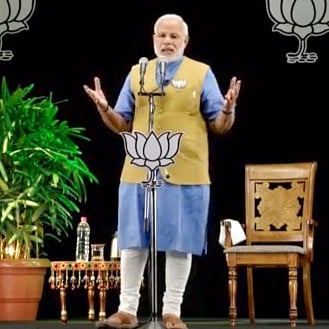
Quickness of reflex was among the distinctive features of the Modi campaign, which led to him earning a triumph on a scale that has been denied any individual or party since 1984. Another of its striking aspects was its immersive character, its ability to invite a large section of an angry and aggrieved electorate into a big tent where Modi would talk to them directly in an idiom that reflected their frustrated aspirations. The statistics of the campaign suggest nothing so much as a methodical and calculated pursuit of power: well over 400 rallies were personally addressed by Modi during a seven month span, and another 900 through three-dimensional holographic projection. In the six week period between the first and last phases of polling, Modi travelled 300,000 kilometres to address nearly 200 rallies. Meanwhile, vans fully equipped with audio-visual technology traversed the far reaches of the country conveying a message of better times to come. This was carried out in tandem with an advertising blitz that saturated every conceivable form of media – whether print, TV, radio, online and outdoor – with Modi's image, and the assurance that he would be the one to deliver 'growth' and 'development', and restore a sense of 'national prestige'.