
It was a sunny morning, bright and beautiful. In the kichen, the family was huddled together, about to sip the hot nun chai, the pink salty tea. The tea had been prepared by Sarwat and it was magical.
"When my Sarwat lal makes it, I don't just taste it – I feel it in my body as its fragrance rejuvenates each and every tendon of my soul," the grandfather had told Zara, Sarwat's daughter, a few days before his death. They lived in a single-storey house near Gulshanpora, a beautiful village in Pulwama District in South Kashmir. Despite struggling to make ends meet, Ibrahim's family of six, had more joys than sorrow. He and his wife Sarwat felt rich when their children were around them.
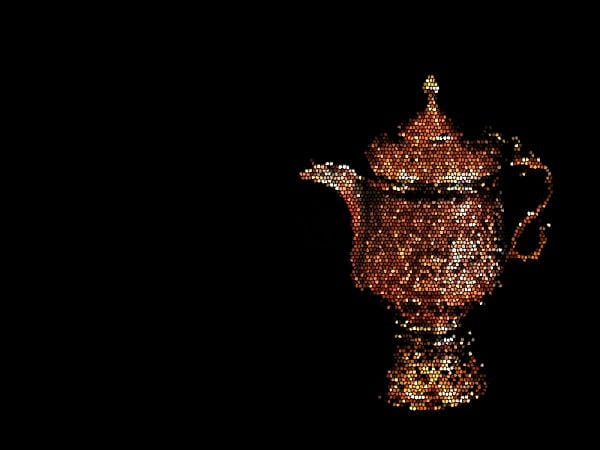
Sitting beside the hot samovar, Sarwat blew a mouthful of air into it. The copper lid clanked as she dropped it back. Sarwat poured the tea into two cups. The steam that leapt out spread a milky smell across the room. Ibrahim sat comfortably in a corner, holding a cup similiar to that of Sarwat's with its floral design. The morning sun passed through through the glass panes and caressed the copper samovar, scattering the light in all directions. The samovar, with chinar and almond leaves carved on it, glitterred as if embedded with diamonds.
The kichen had been partitioned with a knee-high concrete wall into two halves – the sitting side and the cooking side. Half a dozen steel glasses standing on the shelf, a few metres from Zainab, caught the sun's rays. On a white-tiled shelf over the mud oven were Sarwat's spice-filled glass jars. Steel, alumunium and copper spoons hung on rusty nails driven into the wall. Beside them stood a decorative almirah, fixed to the bright, tiled wall of white, its zig-zag shelves holding delicate chinaware. Pictures of Shalimar and Nishat gardens were hung on each wall.