
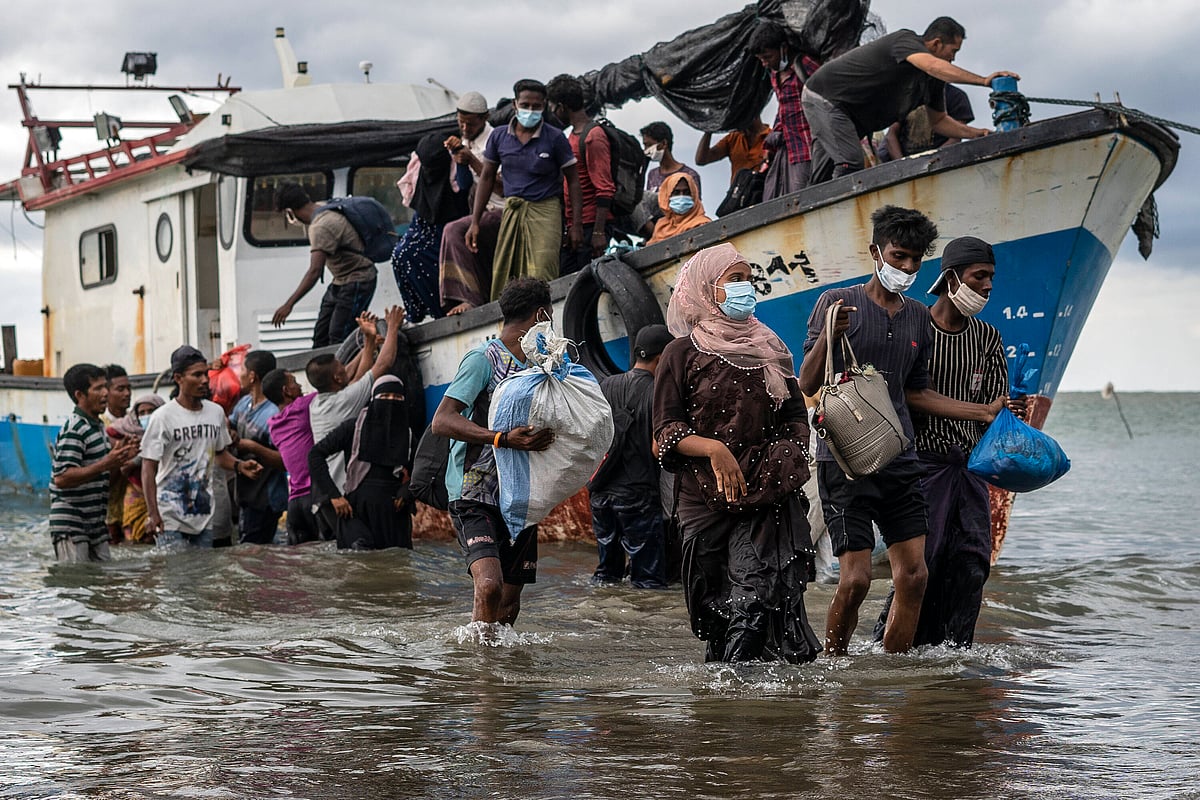
In early March, Myanmar's military junta took diplomats from Bangladesh, India, China and the Association of Southeast Asian Nations (ASEAN) countries to Maungdaw and Sittwe in Rakhine state, on the country's western coast, to show apparent preparations to begin repatriation of the Rohingya. The diplomats were told that the Myanmar authorities want to start piloting the repatriation process soon, but without any clear date given.
One may recall that in November 2017, months after a military crackdown on the Rohingya drove vast numbers of them out of Rakhine, Myanmar's civilian government of the time, led by Aung San Suu Kyi, signed a bilateral agreement with Bangladesh for repatriating what it called "Forcibly Displaced Myanmar Nationals". Bangladesh was then grappling with hundreds of thousands of Rohingya refugees who had poured in across the border from Rakhine; their number in Bangladesh now is more than one million. China mediated that bilateral deal to help Myanmar, an ally, temper the immediate global backlash to the crackdown. Since then, China has been arguing at the United Nations and other international fora that, instead of sanctions and accountability mechanisms to discipline Myanmar officials for their actions, the Rohingya issue should be left to the bilateral level. According to the 2017 accord, the deadline stipulated by Bangladesh and Myanmar to complete the first phase of the repatriation process was within 2018 – but that passed without any progress. In 2019, another Chinese attempt to persuade Myanmar to resume Rohingya repatriation ended in failure.
Six years after the failed bilateral deal, it seems China has now made a third bid at mediating repatriation. This time, however, Myanmar is under the full control of its powerful military, which has removed the civilian administration. The military seized power in February 2021 and nullified a democratic election, setting the country on a course of internal strife and armed rebellion that has left thousands dead and displaced over 1.5 million people. The National League for Democracy (NLD), the victor of the nullified election, formed a government in exile – named the National Unity Government (NUG) – that has been recognised by many Western governments. These developments, somehow, have changed the priorities of the international community, making the restoration of democracy in Myanmar supersede resolving the plight of the Rohingya. But there is a silver lining to all of this. The NLD, which bears significant responsibility for pursuing discriminatory policies against the Rohingya, has admitted its mistake and promised full citizenship rights to them. A UN fact-finding mission in 2019, when the NLD was in power, concluded that the evidence pointed to "genocidal intent" on the part of the Myanmar state.
A path home