
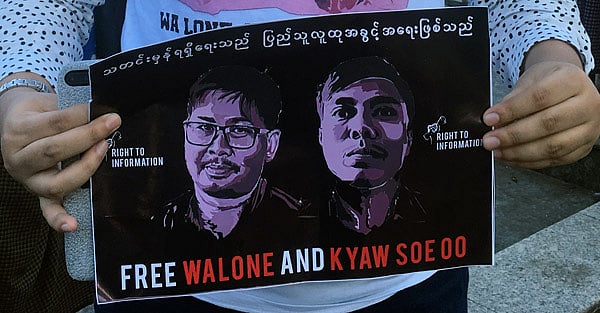
In September 2018, youth of Yangon came out in dozens to protest, gathering outside Yangon's central Mahabandula Park under the scrutiny of the police. They demanded the right to information and the release of Wa Lone and Kyaw Soe Oo. Mostly under 30, the activists were energised and chanting slogans of "Free Wa Lone and Kyaw Soe Oo". The placards they held up read: "If press freedom is shut down, democracy will fail", "The public has a right to information" and "A massacre is not a state secret" – bold statements in a country where many media organisations blackout any news about the Rakhine State, except the official narrative.
Myanmar journalists Kyaw Soe Oo and his colleague Wa Lone were found guilty of breaching the Official Secrets Act and sentenced to seven years in prison earlier this month. They were arrested in December 2017 while investigating a mass grave in Inn Din village in the Rakhine State. It was established during the trial that they were trapped by the police who invited them to a Yangon restaurant to handover 'secret' documents. The story they were working on was later published in February 2018 by Reuters and the policemen responsible for the Inn Din killings were sentenced. Human-rights defenders, however, say the judgement against the two journalists sent a clear message that Myanmar would punish anyone revealing atrocities happening in Rakhine – it would be considered an anti-national act. Not only has the government banned the use of the word Rohingya, terming them 'Bengalis', but prevented reporting on the Rakhine, even banning the team of United Nations investigators from visiting the area.
Until now, the government view that taking up the cause of the Rohingya is anti-national seems to have been reflected in the media and civil society. The country's media has in fact exercised self-censorship, mostly publishing stories which reinforce the official narrative about the Rohingya crisis.
It is still unusual to see public protests against policies of Aung San Suu Kyi's National League for Democracy government, especially if there is a direct or indirect link with Rakhine. However, it is also a common belief that media freedom is enshrined in the doctrine of democracy, which explains the more widespread protests on the incarceration of the two journalists. It is also the reason why throughout the trial many Myanmar activists and journalists remained hopeful that the Reuters duo would not get harsh punishment or would be pardoned soon.