
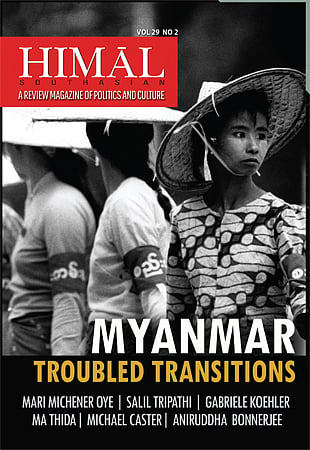
As we discussed putting together this issue, a not-unexpected debate broke out within Himal Southasian's editorial team. Were we going to call the country 'Myanmar' or 'Burma'? Himal had stuck to 'Burma' through all the years of reporting on the junta, for the same reasons that democracy activists were using it – symbolising protest against the military dictatorship which had formally renamed the country. However given the difficulties already surfacing with governance, human rights and inclusion in the newly democratised country, there were suggestions that we should go back to 'Burma', for the same reason that we had stayed with that term for so long.
The editors' decision to start using 'Myanmar' in 2013 was based on the arguments of Nandita Haksar, the human-rights lawyer and activist, who has defended many pro-democracy activists from Myanmar. As we were editing her article, she wrote to us, "I know Daw Aung San Suu Kyi has said she prefers to call her country 'Burma' because the military junta changed the name to 'Myanmar' in 1989 without consulting the people, but then the British did not consult the people when they changed the name of the country from Myanma Pyi to Burma. International law recognises the country as Myanmar." Burma, she said, could be used when the context dictated.
Some argue that 'Myanmar' should be the only name used now, since 'Burma' is derived from the primacy of the country's largest and dominating ethnic group, the Bamar. But that argument does not take us too far. Both names originate in the same root word, Bama, which is the colloquial form of Myanmah. We have used context, as Haksar suggested, to guide our usage.
One can of course overdo it, and so we have followed advice from our contributor to this issue, Mari Michener Oye, not to use the convoluted 'Myanmarese'. We have followed most other official spellings such as Ayeyarwaddy (instead of Irrawaddy), Yangon and Naypyidaw, with the exception of the term 'Rohingya', which the Myanmar government does not recognise but we use, believing the self-identification of the community is a human-rights issue.