
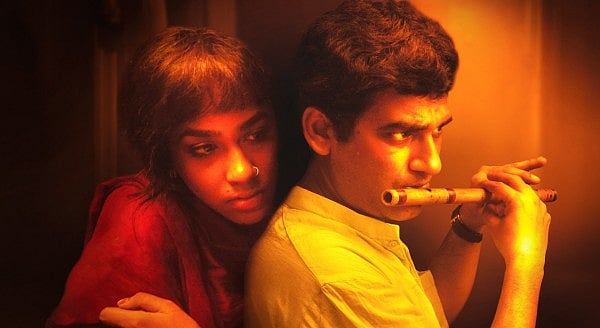
Nagarkirtan is the kind of film we need to see more often than we get to. Before its release in February 2019, word had spread that the film had bagged several National Film Awards in India, including a Special Jury Award (Feature Film) and Best Actor awarded to Riddhi Sen, who plays the film's transgender protagonist. That the film had piqued popular curiosity in Kolkata was palpable; on its release it ran to packed houses and maintained momentum for weeks on end. Now, after running successfully in Kolkata for more than 50 days, Nagarkirtan brings with it the promise of braver, more sincere, representations of marginalised communities in Bengali cinema.
Pnuti, or Parimal or Pari or Rinku, is a woman who was assigned male at birth. That she was not allowed to settle into an identity is made clear by the various names she uses to refer to herself and by which she is referred to by her natal and chosen families throughout the film. Madhu, who works as a delivery agent for a Chinese restaurant and occasionally doubles as a flautist, is a cisgender man who sees Pnuti for who she is – a woman. Their relationship offers Pnuti validation of her femininity but also brings about occasional insidious crises in her self-image, owing to Madhu's struggles with his sexuality. Madhu has only heterosexual language for his desire for Pnuti. While attempting to secure his own sexual identity, Madhu requires Pnuti to keep wearing her wig at all times, even to the point of telling her that he does not like her "patchwork" womanhood – a transphobic moment in the film that is at once crude and necessary to articulate how compulsory heterosexuality disciplines, limits and monitors Madhu's desires – in turn, leading him to regulate Pnuti's feminine presentation. What is to him a dire necessity, what gives him respite from his nagging contestations with himself, further contributes to Pnuti's sense of her undesirability and dysphoria. In its nuances, the film holds a mirror to our society, where transgender individuals are obligated to pass within the binary, as either male or female, to qualify as worthy not only of love but claims to a dignified life.
At a critical moment in the film, Madhu asks Pnuti – evidencing his internalised homophobia – if it is possible for a man to fall in love with another man? Pnuti accommodates the conflicts in Madhu's perception of their reality and reassures him that their relationship is evidence of its possibility. But, in the next moment, she asserts the truth of her being and asks Madhu if he had felt she was anything but a woman while they made love. Madhu answers in the negative – an affirmation of Pnuti's being that also reveals her helplessness. Pnuti is always at the mercy of other people and their definitions of who she is – her family, the state, the societies and communities she inhabits. Her agency is always limited.
The film also depicts the intersectionality of class and desire, not often found in more glitzy neoliberal representations of gender and sexuality. Pnuti earns her living by begging at traffic lights and lives with her hijra family in a dilapidated building coveted by promoters. Madhu occupies a room in a slum, which he eventually loses to gentrification. Madhu witnesses houses being razed to the ground; his gaze strays to a striking high-rise building in the distance. In the film, development exists in an unholy alliance with dispossession. This precariousness is crucial to the narrative itself: Madhu temporarily seeks shelter in the same building as Pnuti after being rendered homeless and their fondness for each other grows from there.