
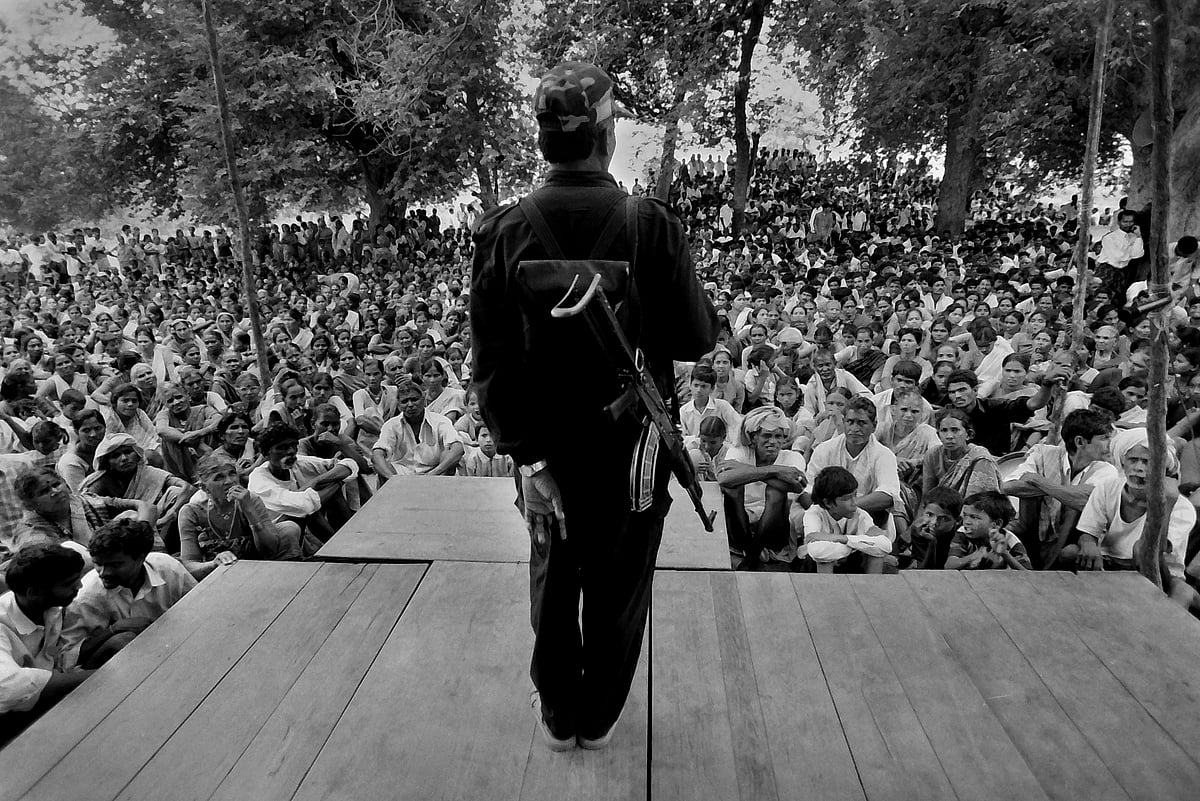
There is no statuette
to measure the miles lovers
cover to torch a police station,
their down or breasts not fully grown
as the ideals they die for.
Hunger too dies.
-Rabindra K Swain, Taking Sides
When dreams die, dreamers who had inspired and led youngsters to the killing fields have to search for ways to cope with the debacle. Some withdraw from public life. A few sell their pasts to secure a comfortable future. Religion, academia and commerce attract the more enterprising among the former visionaries. Invariably, the leftover nihilistic adventurers continue to live within the strands of their memories, until the disgrace of defeat forces them to commit suicide. Japanese samurais, for instance, knew that there was no disgrace in the ultimate sacrifice, and hara-kiri was in fact the last escape from a life of diminished dignity and besmirched honour. Along these lines, Kanu Sanyal (1929–2010) probably thought that there was no point in continuing a life that had ceased to be relevant to the causes he had championed. On 23 March 2010, the last remaining initiator of the Naxalbari movement committed suicide by hanging himself in his native Hathighisha village, near Siliguri. Perhaps he was disillusioned that the standard-bearers of the proletarian revolution now believe in blowing up entire patrols rather than in targeting individual exploiters.
In an unconnected but related event, in mid-April 65-year-old Digendra Rajbanshi hung himself in front of the palatial headquarters of his Marxist-Leninist party in Kathmandu. During the early 1970s, inspired by the Naxalbari uprising, some enterprising Nepali youths, including Rajbanshi, had started what was known as the Jhapali Movement, named after the district in which the movement began. But over the years, he saw his dreams sacrificed on the altar of power politics. A new bunch of armed revolutionaries had claimed the legacy of the Jhapali Movement, and his former comrades had morphed into the 'class enemy' they had once wanted to behead. In the process, Rajbanshi had lost all hope, and been reduced to a skeleton of his revolutionary self.
Very few among the Twitter Generation know of the fascination Naxalbari once held for the youth of Southasia. Though it may have failed to achieve its goals, the ideals Naxalbari set forth is likely to survive in different forms for as long as there is crass inequality, gross injustice and rampant exploitation in society. If anything, the massacre at Dantewada, in Chhattisgarh, and its aftershocks show that the confrontations of the future might well be bloodier, messier and more widespread than ever before.
Brand equity
One of the least publicised facts about India's democracy is how the rich have hijacked all its processes, through their control over money, muscle and the media. Many mukhiyas drive around in the latest Marutis, sarpanchs ride Bolero SUVs, lawmakers are frequent passengers on private jets, and helicopters have become the favoured mode of transport for powerful politicians. London-born and Calcutta-educated former international civil servant Shashi Tharoor, who is often pilloried in the press for showing a penchant for the highlife, was probably only slightly less hypocritical than several of his colleagues in the Indian Parliament, a body that bristles with crorepatis and criminals. Indeed, estimates suggest that more than 300 out of the 543 members in the Lok Sabha are multi-millionaires. Perhaps part of their collective fortune comes from breaking the laws that they make – over a quarter of all MPs have criminal charges pending against them in various courts. All this takes place in a country where the Central Planning Commission has accepted that the number of people living below the poverty line (BPL) account for 37.2 percent of the total population. Yet the major concern of the ruling class is not BPL, but rather the projected INR 300 billion commercial enterprise called the Indian Premier League (IPL), which has less to do with the game of cricket than with the glamour of branding.