
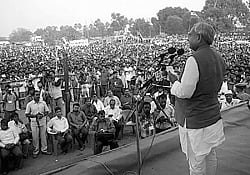
Embarking on his Vishwaas Yatra, trust tour, from idyllic Valmikinagar on the Nepal border early last summer, Nitish Kumar took to the jungles of the Valmiki Tiger Reserve. The terrain was also feared to be Maoist turf. The Bihar chief minister was undertaking a journey of confidence. Carefully moulded tiger 'pugmarks' had been placed along his jungle path by forest officials who also placed a camera trap on the trunk of a teak tree. After taking a look at the 'pugmarks', Nitish walked past the camera – a perfect photo opportunity. Indeed the symbolism of this scene resounded for this writer through the silence of the forest, despite the make-believe pugmarks: Nitish represents a nearly extinct breed in the jungle of Indian politics. Today, finding an honest, sincere neta, with the added gusto of political will, is as elusive as the sighting of the shy, increasingly rare tiger.
Tracking his fourth consecutive yatra from the Champaran region, my mind wandered back to Nitish's first such journey. In 2005 he undertook the Nyaya Yatra, justice tour, starting from the then-dreaded environs of Bagaha in West Champaran district, the nerve centre of the kidnapping-for-ransom industry. His plan then was to seek a mandate from the people to rid Bihar of the 'jungle raj' – the epithet given to the long years of the regime of Lalu Prasad and his wife, Rabri Devi. The Nyaya Yatra took him to all corners of the state over back-breaking potholes for what passed off as roads under a regime whose helicopter-hopping leader, Lalu, had famously not felt he needed. 'The rich drive in motor cars,' Lalu had said, 'not the garib-gurba [poor].' His political rhetoric had made him a messiah of the downtrodden, even as the helicopter rotors whined in the background. But for how long he could maintain the façade of messiah remained to be seen.
Lalu did give a voice to the backward classes. But he was not the lone face of Mandal politics in Bihar. His arrogance and whimsical 'durbar politics' saw Nitish Kumar, his former close associate, leave his side in 1994. That did not bother Lalu, who saw himself as the sole face of the politics of the downtrodden, and the political firmament that he wove increasingly became a web of corruption, crime and rampant lawlessness. And when he could not ride to electoral majority on his own, he found a passive ally in the name of secularism: the Congress party. Raising the issue of secularism, which had helped him secure the Muslim vote in the past, Lalu repeatedly lampooned Nitish as a lackey of the 'communal' BJP. But this strategy did not work this time round or in the previous Bihar assembly election in 2005. Stints in the National Democratic Alliance (NDA) government in New Delhi had given Nitish the opportunity to showcase his prowess at governance at the centre, and his politics of managing political contradictions – both of which were to later pay rich dividends in Bihar.
Pushed to the wall of poverty, Biharis, cutting across caste, creed and class took the only way out: they migrated. Yes, the migrants faced ridicule, but faced with the black hole back home, they persevered. Soon, Bihari grit and enterprise became bywords for success stories outside Bihar. 'You can take the boy out of Bihar, but you cannot take Bihar out of the boy,' author Amitava Kumar once wrote to me on the subject of Bihar's shining diaspora. But he, as well as other expatriates, such as Sanjay Pradhan, the vice-president of the World Bank Institute, amidst countless others, also shared the common angst of their home state withering away to political bankruptcy and corruption – all gloating over the edifice of caste. Migrants who worked as auto-rickshaw drivers, car-park attendants, vegetable vendors and in various other sundry jobs in the metros, the farms of Punjab and industrial townships like Ludhiana or Faridabad, too rued the reason for their exodus: high crime and lack of opportunities. This all-pervasive feeling of despondency is what gave Lalu's adversaries an opportunity to unseat him.