
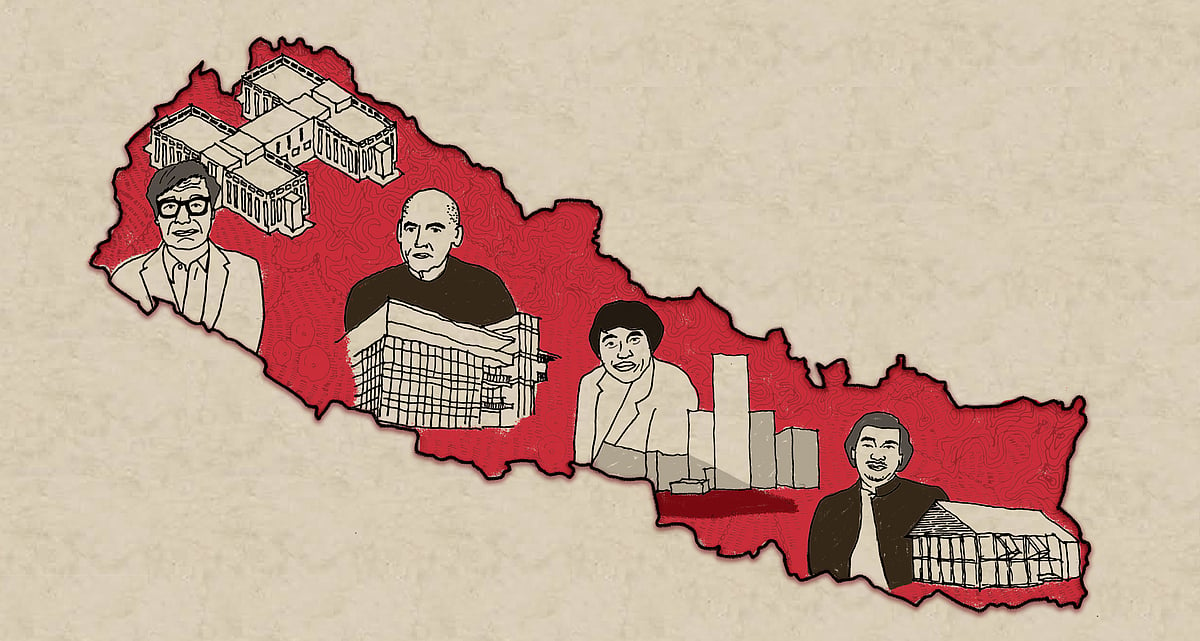
IN 2015, two devastating earthquakes hit Nepal, killing about 9000 people. The earthquakes, measuring 7.8 and 7.3 in magnitude, also destroyed the homes of some 500,000 people, with central Nepal suffering the most. Much of the damage involved buildings that were not constructed to withstand earthquakes or had been poorly maintained. In the aftermath, organisations working to rebuild in badly hit areas invited the celebrated Japanese architect Shigeru Ban to design resilient new housing for the Himalayan region.
Nepal has a long history of earthquake-resistant architecture. Traditional buildings of the Gurung community in central Nepal are based on dry masonry combined with timber structures for the floors and roofs. The Lepchas of the eastern Himalaya build nine-pillar houses and other structures often raised off the ground. These styles have proven to be highly earthquake resistant.
Ban had made a name for himself in post-disaster construction when he designed disaster-relief shelters in Christchurch after an earthquake hit New Zealand’s South Island in 2010. His quick-build community buildings had also helped rehouse survivors of natural disasters in Rwanda, Turkey, Japan, China, India and Haiti. His style focused on structural strength and the use of local materials, and he had famously developed construction material from cardboard tubes used in the Japanese carpet industry. He had also won the Pritzker Prize, considered the highest honour in architecture, just the previous year.
Ban started his design work supported by his own Voluntary Architects Network and the Nepal-based Saraf Foundation. His team identified disaster-hit areas and recruited the local architect Sanjay Thapa. As Ban completed his concept design, magazines such as Domus, Architectural Review, Dezeen and ArchDaily ran articles on his “Nepal Project”, accompanied by 3D-rendered images of the prototype’s exteriors and interiors as well as plans with design details. Each house was to have connecting modular frames and the wall cavities in these frames were to be filled in with bricks salvaged from the earthquake rubble. Cardboard tubes were to form a trussing to support the roof. ArchDaily highlighted Ban’s claim that the simple design could be “easily assembled by almost anyone.”