
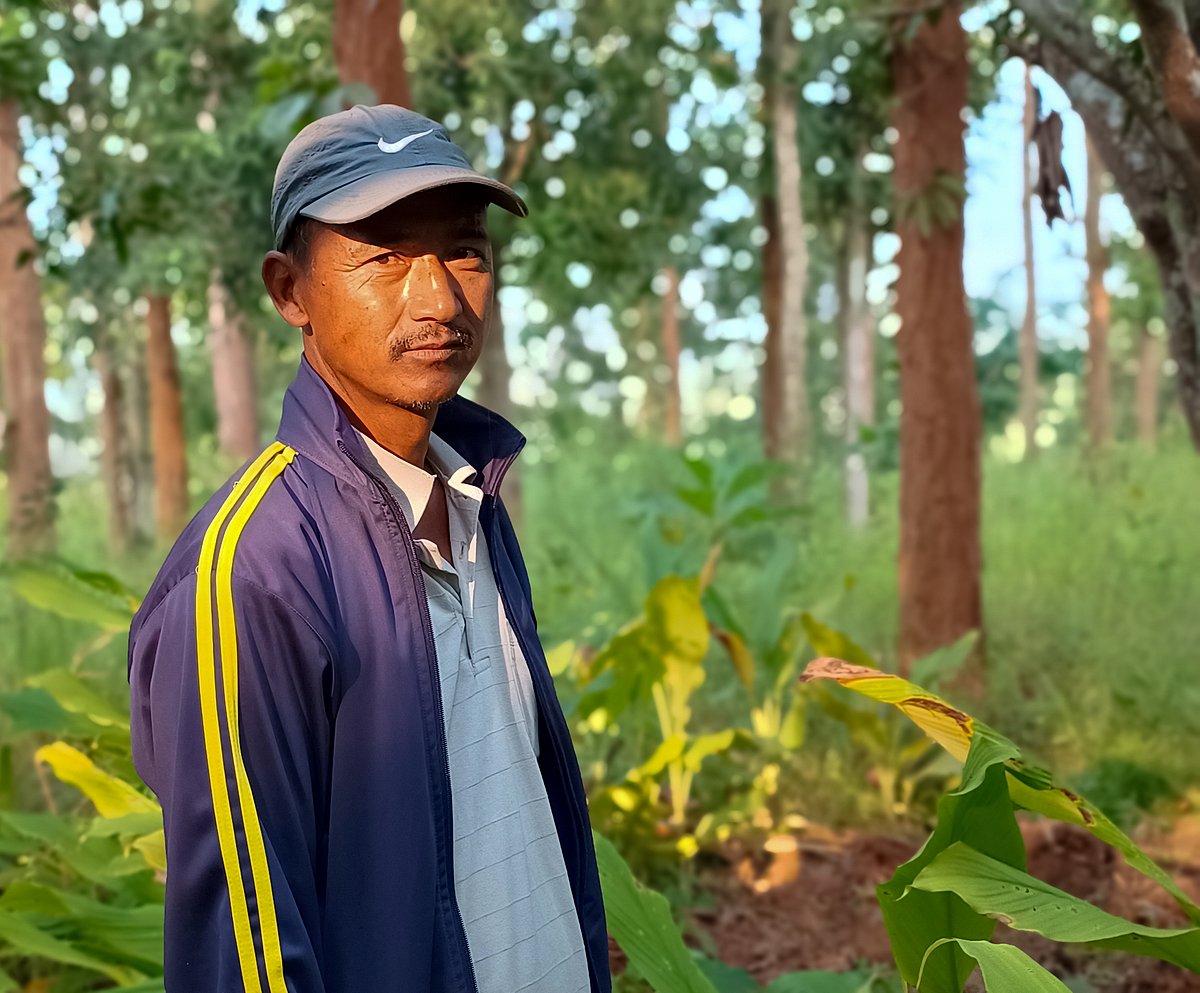
“WE DON’T GET rain on time anymore,” said Purna Rana, a 51-year-old farmer in Sathikola village in mid-western Nepal. It was the middle of November 2023 and the winter chill was beginning to set in. “The summers are hotter and winters are colder each year,” he continued. “Last winter, I lost my tomatoes to a combination of mosaic virus, white flies and extreme cold.” Rana has been fighting all these threats even as extreme weather conditions exacerbate farming risks every year.
Rana was not always a farmer. He went to India to find work in 1991, when he was just 19. He trained as a radio repairman and electrician and shuttled for work between Shimla, Mumbai, Delhi and numerous small towns between these cities. After 21 years as a migrant, he returned to Nepal in 2012. He first planned to use his experience as a radio repairman to provide for his family, which included two school-going children. He made the hopeful but ill-considered move of opening a radio repair shop in his village. “How many radios do you think this village had?” he asked. Even the handful it had were soon made redundant by cheap mobile phones that doubled as radios.
Rana knew little about farming at the time, but a lack of options made him turn his full attention to the 1.5 acres or so of land in his possession – a large holding compared to the average in Nepal. He got a new electricity connection, installed a water pump and laid pipes for irrigation. The pump drew water from the Bheri, a major tributary of the Karnali River. In a country of many rainfed farms, Rana’s enterprise, combined with a location close to a river, pulled him into a relatively resource-rich agricultural bracket. But it cost him money – about NPR 1.5 lakh, or USD 1690 at the time – and the electricity rates are also high, not to mention the numerous other costs Rana incurs to continue farming.
“Migration, agriculture and climate change are closely interrelated in Nepal,” said Nilambar Badal, a labour migration expert at the Law and Policy Forum for Social Justice in Kathmandu. Agriculture in Nepal is characterised primarily by smallholder subsistence farming. About 70 percent of landholdings are of less than one hectare, with the average parcel size just 0.19 hectares. With only 54 percent of the total cultivable land area under irrigation, crop productivity is low. People dependent on agriculture, particularly in western Nepal, are among the poorest in the country.