
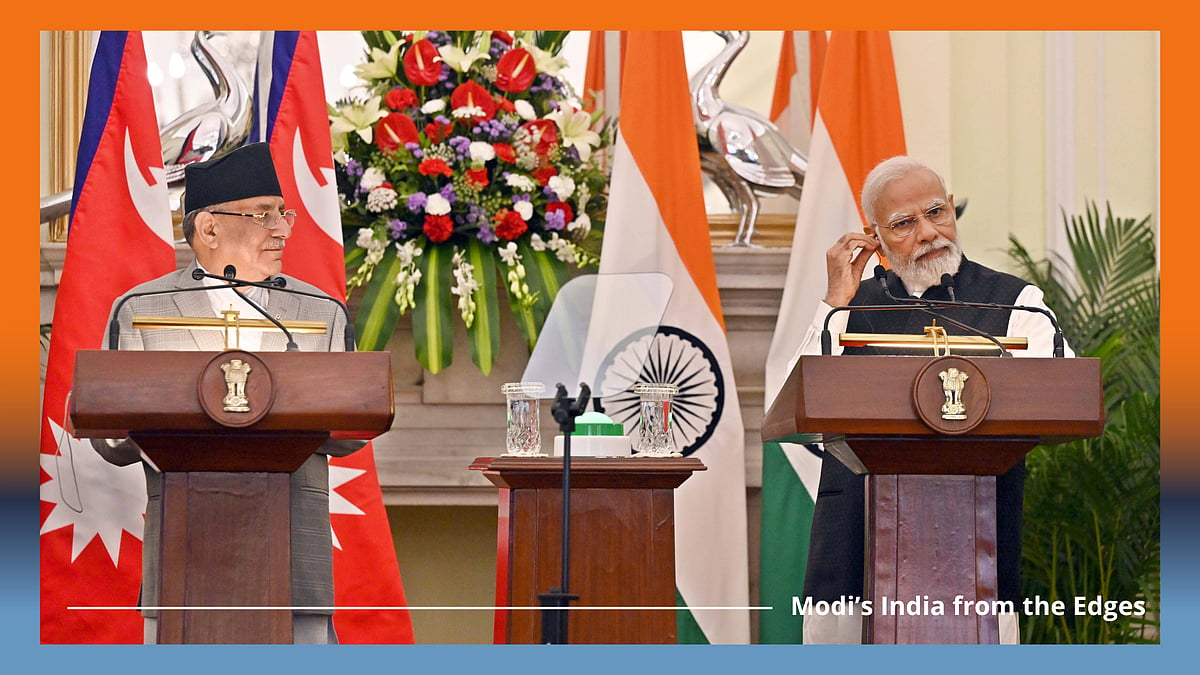
This story is part of ‘Modi’s India from the Edges’, a special Himal series presenting Southasian regional perspectives on Narendra Modi’s decade in power and possible return as prime minister in the 2024 Indian election. To read the series and support Himal’s work on it, click here.
AT THE START of his book Kathmandu Dilemma: Resetting India-Nepal Ties, Ranjit Rae, a former Indian ambassador to Nepal, revisits a question that the Indian prime minister, Narendra Modi, posed to him in 2015. Nepal had just suffered a devastating earthquake that had killed thousands, and India had rushed to its aid with money, materials and men for relief and rescue. But the Indian media’s insensitive and jingoistic coverage of the crisis upturned the goodwill Indian relief efforts had generated. “Why don’t they like us?” Modi had asked Rae, revealing the depths to which India–Nepal ties had sunk in Modi’s second year in power.
Almost ten years later, the journalist Prashant Jha wrote this January that the “state-to-state relationship with Kathmandu has not just steadied but deepened on the three parameters that matter to India – security, connectivity, and economics.” This suggested a smoothening of ties from both ends, despite the 2015 blockade of the India–Nepal border, the 2020 border dispute between the two countries and China's emergence as a political and economic alternative to India in the last decade. One could attribute this to the cliché about Nepal–India ties being “special”, but a more nuanced analysis would suggest both Kathmandu and New Delhi are willing to leverage their strengths to expand the bilateral relationship despite irritants. The caveat is that unless these irritants are resolved soon, they can potentially act as the future determinants of the relationship.
UNDER WHAT HAS been described as Modi’s assertive Hindu nationalist foreign policy, the intersections between New Delhi’s foreign outlook and domestic politics are more profoundly visible than with earlier Indian governments. The dangers of an overtly nationalist domestic electorate’s demands feeding into India’s foreign relations cannot be overstated. This is perhaps clearest within the Southasian neighbourhood, where Indian influence has historically been regarded as hegemonic and where anti-Indian sentiments have often formed a bedrock of domestic politics in neighbouring states, as in Nepal. In turn, New Delhi has leveraged its political and economic influence, often forcefully, towards securing policy outcomes more suitable to it.