
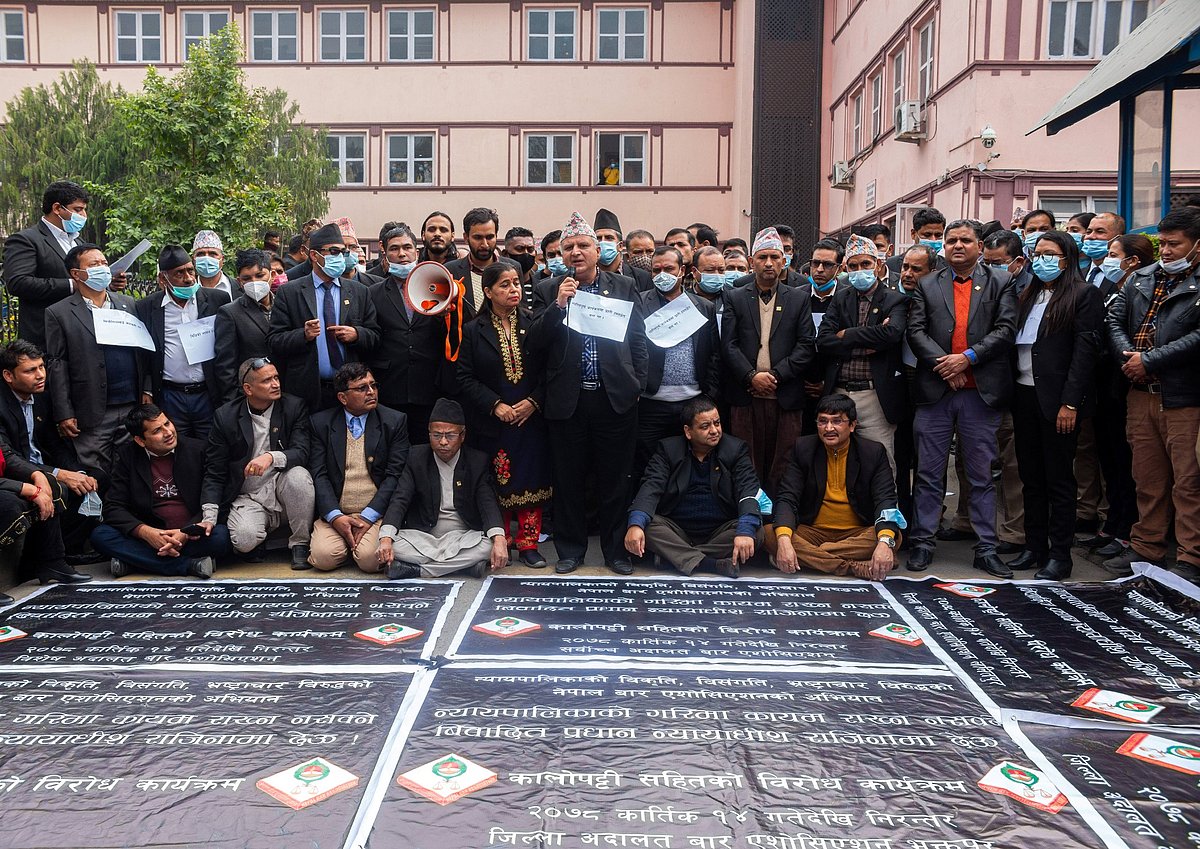
In late October 2021, in an unprecedented turn of events, the Nepal Bar Association (NBA) – an umbrella body representing nearly 20,000 lawyers in the country – along with retired justices of the Supreme Court and many senior advocates, publicly demanded that the current Chief Justice (CJ) Cholendra Shumsher Rana resign from his position. This occurred soon after the newly formed government led by Prime Minister Sher Bahadur Deuba, appointed Gajendra Bahadur Hamal, Rana's brother-in-law, as a minister. This decision was allegedly on the request of the Chief Justice himself, which if true would be a blatant – potentially impeachable – disregard of the principles of separation of power and maintaining an independent judiciary.
More dramatically, 14 of the 20 office-holding Supreme Court justices too demanded Rana's resignation and boycotted full court meetings called by him, indicating a deep fissure at the very top of the country's judiciary. Remaining justices of the Supreme Court have also joined the campaign, refusing to hear cases for three weeks apart from habeas corpus petitions, and demanded judicial reforms, echoing a larger demand shared by many in the country. The NBA had also requested parties in the parliament to introduce an impeachment motion.
After months of uncertainty, 98 lawmakers from the ruling coalition registered an impeachment motion with 21 charges against CJ Rana on 13 February, 2022 – automatically suspending him. A month later, the parliament formed an 11-member Impeachment Recommendation Committee to study the allegations against CJ Rana. However, the Speaker of the House delayed the impeachment proceedings for five months by not forwarding the motion to the Impeachment Recommendation Committee – which had summoned Rana on several occasions starting from 31 August, 2022.
On 17 September, 2022, the last day of parliament's five-year term, the committee recommended the full house of parliament begin impeachment proceedings against CJ Rana, with the majority vote of six members who represented the ruling coalition. The remaining five members – who represented the opposition – wrote a note of dissent against the impeachment. In a cat-and-mouse fashion, Rana called the Supreme Court administration and stated that he would be rejoining the office. He argued that his impeachment motion ceased to be effective as parliament stood dissolved. Security guards seemingly obstructed him from leaving his residence after he made that call. CJ Rana and former Prime Minister KP Sharma Oli have even spoken to the media stating that the government has kept Rana under undeclared house arrest, a move that would be unconstitutional and unprecedented since Nepal's peace process. However, there's too much blood on the hands of those involved to decipher the moral and legal underpinnings of this turn-of-events.