
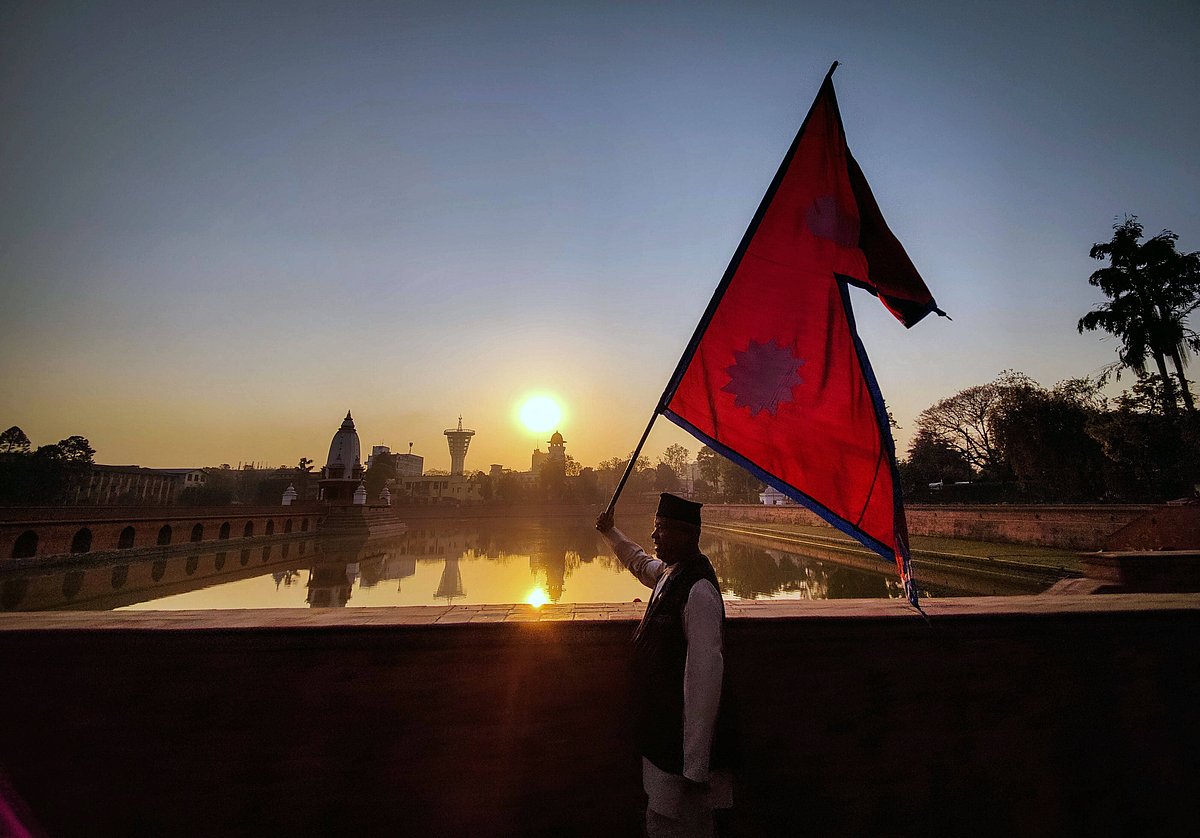
The most important step towards consolidating the Nepali state and nationalism is to end economic exploitation and to bring about social equality. Caste hierarchy also perpetuates economic class division. Nepal's constitution that gives primacy to one religion and one language, provides substance to the perpetuity of social disparity. A multi-ethnic, multi-linguistic and multi-religious Nepal should have a constitution that is secular. That will be the beginning of national integration.
Since consolidating Nepali nationalism implies conserving something that exists, it seems important to enquire into the extent to which the Nepali state/kingdom has evolved into a nation. This requires analysing the foundations of Nepal as a nation. Four dimensions will be examined in this context: the making of Nepal; neighbourhood entanglement; national identity; and consolidation strategy.
The making of Nepal
The status of countries are determined by the current of history. In the case of modern Nepal, one can recognise three incarnations: the 'proto Nepal' of Kathmandu Valley; the 'imperialist Nepal' which stretched from the Tista river in the east to the Sutlej in the west; and the 'feudal Nepal' confined by the Mechi and Mahakali rivers. The reference to "Nepaldeshe" in the "Jambudwipe-Bharatkhande…" incantation of the Hindu priest is not to today's extended kingdom but to the Newar state of Kathmandu Valley. Its rich religious and cultural heritage are eulogised in the Sanskrit Himvatkhhanda and the Tibetan Dzam-gling-Getse. The indigenous people of proto Nepal were the Kirant, but the Valley's agricultural productivity and mercantile wealth lured distant conquistadores.
States grow around a nucleus and expand by conquest and aggrandisement. Proto Nepal, however, remained fixated on cultural creativity rather than imperial expansion. Whenever the Khasa of the Karnali region felt strong and powerful enough, they would invade the Valley and return with the loot. The Sen dynasty of Palpa succeeded in extending east to Bijayapur but were based in the foothills, and later broke up into four patrimonies. After the 16th century, the Khasa of Gandaki expanded eastwards after capturing the Magarant principalities. It took the Khasa expansionists under Thakuri chiefs (successively called Khan, Sahi and Shah) only 58 years to subjugate areas from Bhirkot to Gorkha. But it took another 185 years for them to cross the Trisuli river, and another quarter century after that to conquer the Valley of Kathmandu. In comparison, the Gorkha army took nine years to reach the Tista (1783), and 17 years to the Mahakali—and reaching all the way west to the Sutlej 23 years later in 1806. The Gorkhali kingdom then commanded a territory stretching nearly 1500 km, and it became difficult to maintain this vast tract. After the 1814-16 war with the British, the country was confined to its present day borders, between the Mechi and Mahakali.