
Although Manekharka is only 80 kilometres from Kathmandu, it takes almost six hours from the country's capital to reach the village, which lies in Nepal's Sindhupalchok district that borders Tibet. The road leading northeast from the capital rapidly deteriorates, reducing the wayside town of Sankhu to a dusty junction. The blacktop here has managed to cling to small segments on the road, but much has fallen off. I spot chunks and strips of asphalt while bouncing towards Melamchi, the largest municipality in that part of Sindhupalchok district. The driver confirms my suspicions: "Yes. This section was once paved. But from Melamchi to Manekharka, never."
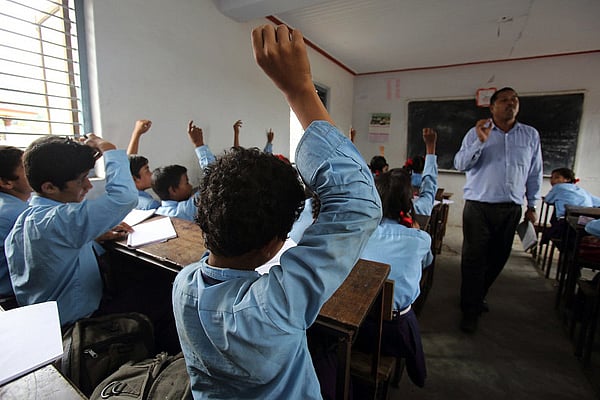
I was travelling to Manekharka – which lies in Panchpokhari Thangpal Rural Municipality – with a group of mentors and musicians as part of an arts-education programme. Jointly started by Srijanalaya (an organisation founded by art educators) and Shikshya Foundation Nepal after the 2015 Gorkha earthquake, Art Works' goal is to introduce alternative, arts-based teaching methodologies to children and teachers in under-resourced public schools. In the past four years, Srijanalaya and its evolving network of professionals have worked with a number of communities across Nepal. In Panchpokhari Thangpal, which was severely affected by the 2015 earthquakes, we were hoping to start a partnership with the municipal government, to provide teaching material and training to its public-school teachers.
Underfunded and often understaffed, public schools – also referred to as community schools – across Nepal have serious limitations in fulfilling their educational duties. Such neglect across public institutions was among the reasons why federalism emerged as a strong agenda following the democratic movement of 2006. Implementation of the federal structure and the subsequent local elections in 2017 were made possible, in part, because of the vocal demands for decentralising political and administrative power concentrated in Kathmandu. Public services could be equitably and efficiently delivered only if they were produced and distributed in close collaboration with the public, it was argued. This would enable multilingual, multicultural communities scattered across the country to finally make decisions regarding their own resources.
But as federalism takes shape in Nepal, school education has emerged as a site of contestation between local aspirations and entrenched powers. Community schools in municipalities like Panchpokhari Thangpal illustrate how necessary autonomy is for the future of its residents' education. Yet the federal government, along with the old gatekeepers of Nepal's schooling system, is increasingly undermining local governments' right to shape their education system.