
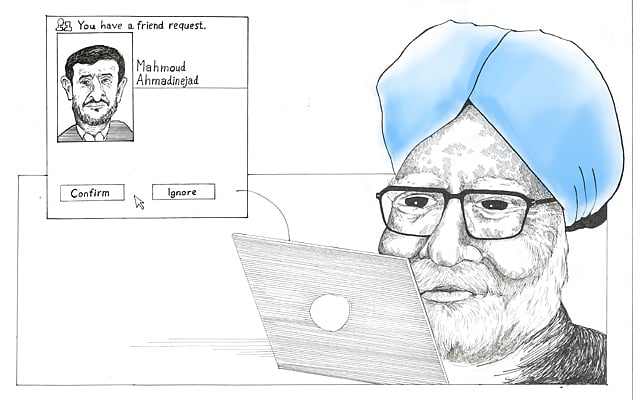
The battle between Iran and Israel has now landed on Indian shores. New Delhi, which so likes to sit on the fence, may now be forced to take a strong stand one way or another. On 13 February, just as an explosive device placed under an Israeli embassy vehicle in Tbilisi was being defused, a 'sticky bomb' attached to a vehicle carrying an employee of the Israeli embassy in New Delhi exploded. The attacks happened almost simultaneously and were clearly targeting employees of Israeli diplomatic missions. A day later, an Iranian man carrying grenades blew off his own legs and wounded four civilians after an earlier blast shook his house in Bangkok. In response, Israel has increased its domestic state of alert, emphasising security in public places, foreign embassies and offices, and at Ben-Gurion International Airport.
Though no one has claimed responsibility for the incidents, the Israeli government has made it clear that it believes Iran and its proxy, Hezbollah, to be behind the attacks. Tel Aviv has used these attacks to underline its concerns about Iran gaining nuclear capability, arguing that if the Islamic republic becomes a nuclear power it could provide greater protection for militant groups emboldened by its support. Iran, of course, has denied responsibility for the bombings, and the Iranian Foreign Ministry has alleged that 'these suspicious incidents are designed by the Zionist regime and carried out with the aim of harming Iran's reputation.'
A covert war is raging with Iran on one side and the West, the Arab Gulf states and Israel on the other. Several Iranian nuclear scientists have been assassinated, while the Stuxnet computer worm has been employed to target industrial software critical to Iran's uranium-enrichment efforts. Recently, arrests in Azerbaijan and Thailand have purportedly disrupted extremist plots aimed at Israeli diplomatic targets, and diffused an apparent threat to Israeli interests in Bulgaria.
Much like its predecessor, the administration of President Barack Obama has vowed that it would not allow Iran to engage in the building of nuclear weapons. Israel is already fretting over its pre-emptive options. Tel Aviv has made it clear, time and again, that it would not hesitate to act unilaterally and overrule American objections if it judges that Iran is getting too close to nuclear weapons capability. Meanwhile, tensions are rising in the capitals of the Arab Gulf states. It was Saudi Arabia's King Abdullah, after all, who famously advised American diplomats that the only Iran strategy that would work was one that 'cut off the head of the snake'.