
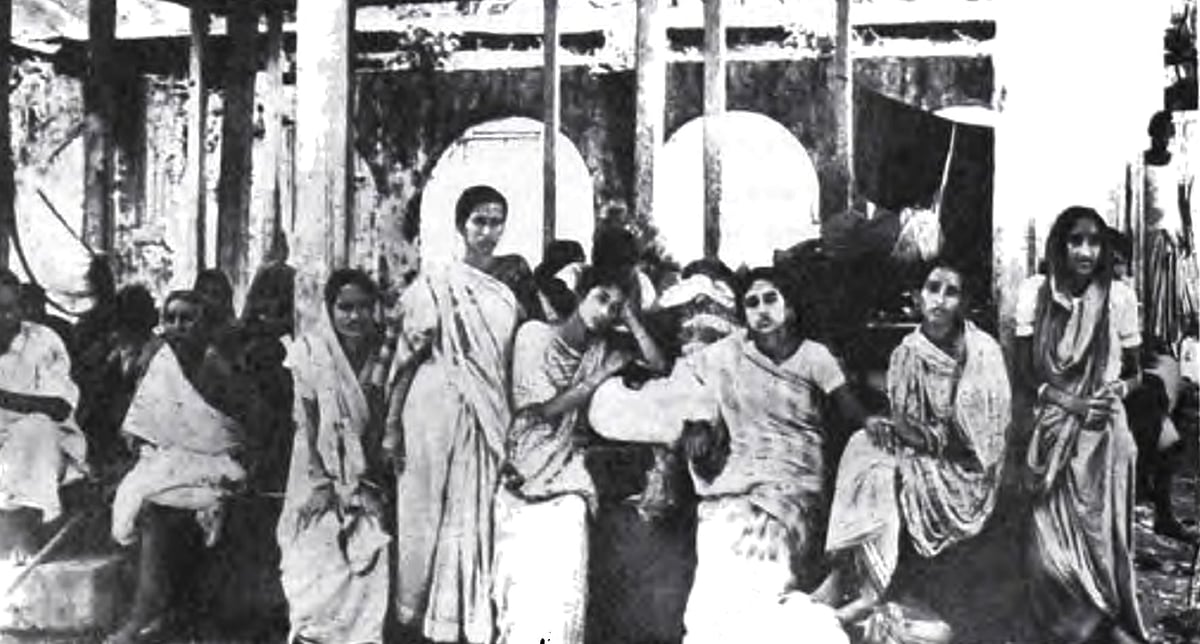
Over the course of the nine months of the Bangladesh Muktijuddho (War of Liberation), in 1971, horrendous crimes were committed by the Pakistan Army and its local collaborators against unarmed civilians. Although exact figures are notoriously contentious, many groups estimate that some three million people were killed, over 300,000 women were raped, and some 10 million people were forced to leave their homes to take shelter in the adjoining states of India. The carnage started on the night of 25 March 1971, when the Pakistan Army, frustrated by the growing strength the independence activists, launched attacks on student halls at Dhaka University, slum areas and neighbourhoods in the capital city, as well as the headquarters of the police and the paramilitary East Pakistan Rifles. This bloodshed continued all the way until December, when the Pakistan Army was defeated and forced to surrender.
In an attempt to crush the growing expectations in East Pakistan, the military regime of General Yahya Khan had put in place a systematic, premeditated campaign. 'Kill three million of them,' Gen Khan had said at a military conference in February 1971, 'and the rest will eat out of our hands.' Thus, in the name of Islam and Pakistan, the people of Bangladesh faced what many today describe as one of the worst genocides of the 20th century. The Pakistani perpetrators of these crimes have fled and never been held to account, but thus far even the local perpetrators and collaborators have eluded justice. It was only on 25 March 2010 that the government of Prime Minister Sheikh Hasina finally initiated a long-overdue move towards trials of the accused, announcing the formation of a tribunal, an investigation agency and a prosecution team under a law that was actually enacted nearly four decades ago, soon after liberation.
In the last general election, in December 2008, the call for the trial of suspected war criminals played a significant role. An overwhelming majority, especially among young voters, registered their unequivocal support for the demand, which eventually became one of the central pledges by the alliance, led by the Awami League, that went on to win the election. In large part, it has been following the restoration of democracy and the introduction of free media in 1990 that the younger generations have pushed to correct distortions that had crept into the country's post-liberation history. During that time, the demand for trial of alleged war criminals has also grown stronger.
Despite popular support the move has faced significant resistance, mainly from the political opposition. The criticism has been particularly severe from the Jamaat-e-Islami, the main fundamentalist party, some of the seniormost leaders of which are widely perceived as war criminals due to their direct abetment of liberation-era crimes. The Jamaat's obstruction of the trial received a massive boost when it was able to engineer strategic support from the country's major political opposition, the Bangladesh Nationalist Party (BNP), led by former Prime Minister Khaleda Zia. For its part, the BNP has officially pledged 'all out' support to the Jamaat, which is a major partner of the four-party alliance it leads. Tactically, the party cannot outright oppose the trial due to the popular support in enjoys, but it has questioned the government's intentions, dubbing the move to try the war criminals as nothing but a 'conspiracy' to crush an anti-government movement.