
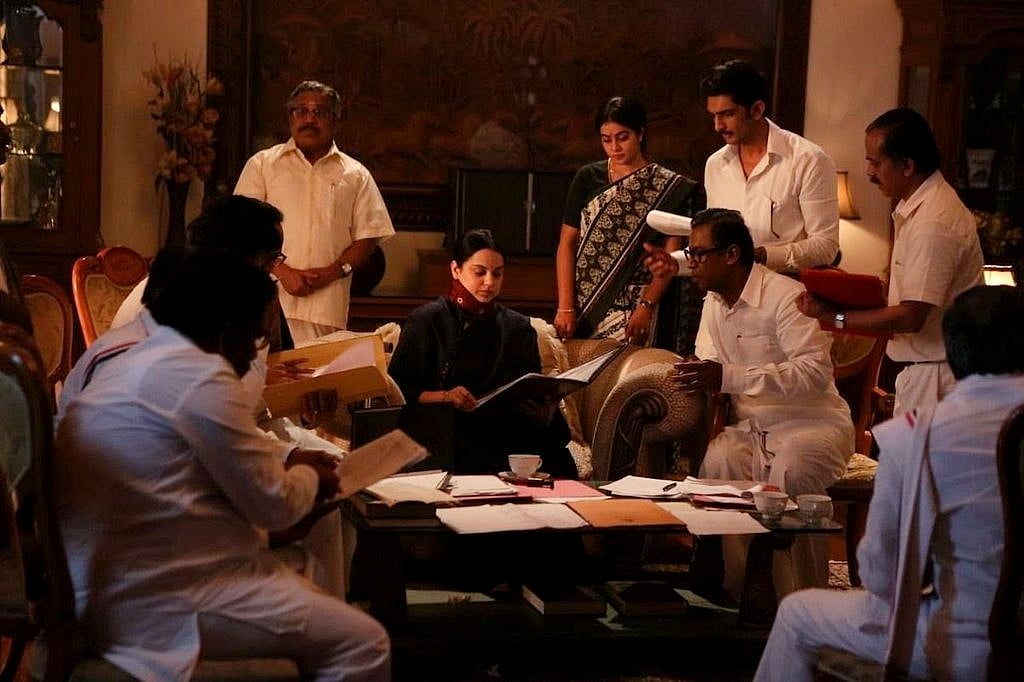
Jayaram Jayalalithaa's biopic Thalaivi (2021), directed by A L Vijay, depicts her journey from a filmstar to prominent politician. Jayalalithaa emerged as a powerful female public figure, first as a popular Tamilian actress and later as a politician holding the position of chief minister of Tamil Nadu for six terms. Although Thalaivi highlights Jaya's – as she is called in the film – influence and fighting spirit, it nevertheless subtly reinstates patriarchal norms. The film portrays her as a victim who goes from strength to strength with the support of her male film-star-turned-politician mentor M G Ramachandran, popularly called MGR, and after his death, by remaining true to his legacy. In emphasising Jaya's relationship with MGR while at the same time erasing her equally strong and influential history with party worker and aide V K Sasikala, the film deliberately foregrounds her life in a heterosexual domain, sanitising it and presenting it in a way whereby she emerges as culturally acceptable to the Brahminical order.
Jayalalithaa as Jaya in Thalaivi
Born in 1948 to an upper-middle-class Iyengar-Brahmin family, Jayalalithaa's early life was not easy. Her father died when she was two. Her mother, Vedavalli (Sandhya), who was only 26 years old, had to start looking after the family. Although Jayalalithaa was academically gifted, her mother convinced her to act in films beginning in 1961. Jayalalithaa went on to rule the Tamil film industry and later emerged as one of Tamil Nadu's most powerful politicians.
Although Jayalalithaa lived an interesting life, mainstream culture narrates her in a highly selective, strategic way, focusing on some aspects of her life while erasing others. Thalaivi is a good case in point. MGR, perceived as a demi-god, a Rama-like figure, already married, is implicitly both upper caste and heterosexual. In the film, his right-hand man and film producer, R M Veerappan, ensures no actress comes close to MGR to tarnish his image in any way. However, Jaya, a young, upcoming actress, manages to establish a close bond with MGR, frustrating all of Veerappan's efforts. Veerappan is so committed to MGR that even after the superstar dies, and even when he knows that Jaya is MGR's true heir in every way, he wants MGR's wife, Janaki, to contest elections. This dedication to MGR and his wife also suggests a dedication to the religious icons Rama and Sita, and their centrality in the collective India psyche. However, it is Jaya who finally succeeds MGR as the premier name in Tamil Nadu politics. Veerappan later supports her as he sees how steadfast she was in her loyalty to MGR. Jaya finally becomes Thalaivi, or leader in Tamil, but this transition from being an actress to a credible politician is not easy. By adopting behavioural traits associated with masculinity in her ways, and also as amma or mother to millions of her followers, she emerges as an ascetic figure. The implied heteronormativity and the framing of women in public life as 'amma', squarely within an ethos of motherhood, strips them of sexuality and evokes the care for and reproduction of the nation. This not only subsumes queerness, but also views female sexuality as a subversive threat to Brahminical caste order.