
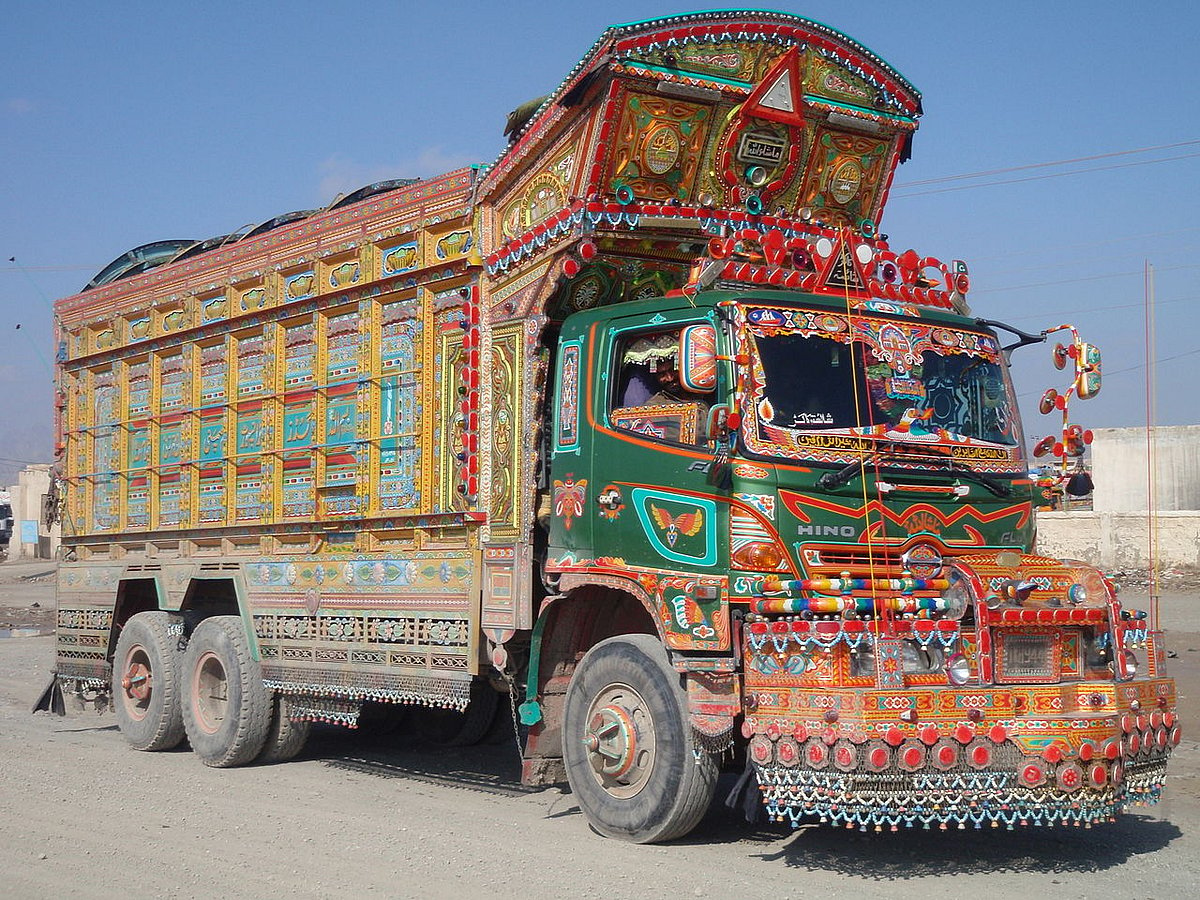
Seven years ago, an archaeologist named Jonathan Mark Kenoyer imported a decorated truck from Karachi into the United States. He recalled recently, "It landed in LA, and then we had to drive it across four time zones to Washington, DC, for the 2002 Smithsonian Folk Life Festival." Such an undertaking only underscores the growing scholarly interest in Pakistani trucks, in particular the well-known artwork and the lesser-known inscriptions that nearly all carry. However, the inscriptions that adorn these trucks have been less noticed. Today, Pakistanis, normally indifferent to the richness and diversity of their own country, have begun to take notice of these inscriptions. And indeed, there is much to be learned from exploring them further.
Out of all the trucks in Pakistan plying the country's nearly 247,000 km of roads, the vast majority have inscriptions written on them in any one (or more) of several languages – Arabic, Urdu, Pashto, Balochi, Brahvi, Sindhi, Punjabi and others. Inevitably, these offer fascinating windows into the worldview of the cross-section of population represented by the drivers, painters and truck owners. This worldview is not typically understood by the media, scholars and urban intelligentsia. Could it be that common Pakistanis have not actually succumbed to the militant version of Islam that has drenched parts of the country in violence? And could these truck inscriptions offer glimpses into aspects of Pakistani culture on which a tolerant, easygoing nation could be built, as the current bout of violence runs out. These, at least, were some of the questions in the mind of this writer when he began to drive the roads of Pakistan, letting his gaze linger a bit longer at this at times mesmerising form of art.
In Rawalpindi, Peshawar, Quetta, Hyderabad and Rahim Yar Khan, a total of 627 trucks were studied and the inscriptions on them divided into some dozen themes. First off were the ubiquitous advisory inscriptions, about life in general and carrying a cautionary or informative note; a good example is the Punjabi maxim, "Phal mausam da gal vele di" (The best fruit is that which is of the season, and the best saying is that which is appropriate for the occasion). Second were inscriptions that pertained to the driver's life, one of perpetual travelling, of not having a fixed home, and of the pride that he takes in his profession; for instance, the Urdu "Driver ki zindagi maut ka khel hai/ bach gaya to central jel hai" (The driver's life is a game of death/even if he survives there is the central jail). A particularly large category was fatalitism, dealing with the idea that there is a fixed, unalterable destiny; for instance, the Urdu "Nasib apna apna" (To each his/her own destiny). On what could be the flip side of that category was goodness, general goodwill and good wishes for all; for instance, the Urdu "Khair ho ap ki" (Bless you).
Then there was the significant subset on Islam, including sayings from the Quran, references to mystic Sufis, pictures of sacred places, and religious formulas; an obvious inclusion, from Arabic, was simply "Bismillah" (In the name of Allah). Although not common some years back, a sub-theme on this was Islamic fundamentalism, which refer to tabligh (proselytizing), the Taliban and general exhortations to pray; for instance, the Urdu "Dawat-e-tabligh zindabad" (Long live the invitation to proselytise). On the other hand, mysticism, also a sub-theme on the Islamic inscriptions, often referred to the shrines of reputed Sufi saints, or to Sufi ideas; for instance, the Punjabi "Malangi sakhi Shahbaz qalandar di" (I am the female devotee of the Generous Shahbaz Qalandar).