
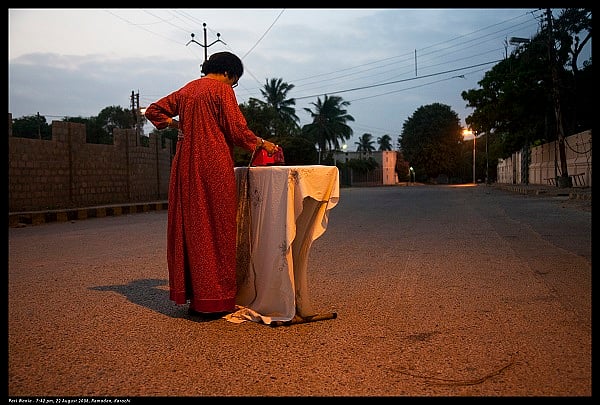
In Bani Abidi's art, laughter is the plumb line, and the title of her sweeping retrospective at Berlin's Gropius-Bau (6 June – 22 September 2019) also suggests so. Sarcasm, satire, irony, and a constant dialogue with the absurd have played an important role in Abidi's work over the past two decades. Such intellectual work induces a certain kind of knowing laughter. What we also glimpse through her work is the multitude of ways in which its cast of characters strives to attain a state where laughter is effortless, carefree and a product of uncomplicated happiness. As Abidi's career evolves, her subjects, attempting to laugh this freer kind of laugh, typically traverse a cityscape that is exhausting, constricting, yet – at unexpected moments – freeing. Equally typically, their attempts invoke, in us viewers, laughter that is biting and cerebral. Depending on our inclination, this laughter can be tinged by an affection for the absurd, rendered by the artist as familiar and recognisable.
Guided by Abidi's strong presence in these works, we laugh at, in the absence of much to laugh with. Yet from that gap arises the urgent realisation that we must, or at the very least we must aspire to, laugh with each other. In her most recent works, an affective hesitancy creeps in, deferring both modes of laughter to a time to come, when a current state of uncertainty will have, hopefully, sorted itself out. Perhaps, when that time does come, we will die laughing, again. Natasha Ginwala's intelligent and empathic curation of this high-quality body of work ensures an immersive experience where we learn through laughter and reclaiming—in this we are led by the people Abidi focuses on, her interpretation of their acts of survival and resistance, and of us, the visitors to Gropius Bau.
***
The retrospective is not arranged in chronological order of the works exhibited. Ginwala has preferred to organise it through thematic and affective circuits that link different moments of Abidi's creative arc to reveal continuities, shifts and changes. We are drawn into the exhibition's cacophonic yet charming heart through a looped video of a Scottish pipe band in Lahore trying to perfect their rendering of the American national anthem with nary a guide, apart from a cassette recorder. 'Shan Pipe Band Learns the Star-Spangled Banner' (2004) brings us into a very desi domestic space, characterised, like the music of the Pipe Band and the clothes and learning techniques of the musicians, by what is called jugaad: the improvised assemblage of unexpected fragments to respond to an immediate need. The Brass Band is attempting to learn by ear the American National Anthem, in order to entertain a wedding party. Through jugaad, the flotsam and jetsam of global modernity, filtered through the imperial and militaristic genealogy of the Brass Band, and flagged up by the choice of tune captured and showcased by the artist, is converted to serve the festive needs of the chaotic postcolony. We will enjoy ourselves by whatever means: irreverence will open up the pathway. Across the room, small watercolour portraits of protagonists laughing near-hysterically, grouped under the title 'And they died laughing', push this understanding to an apocalyptic brink. The portraits were made in visceral response to the 2015 assassination of activist and cultural entrepreneur Sabeen Mahmud in Karachi – an assassination motivated, it would seem, by her fearless work in keeping open spaces for conversation, discussion, debate, and laughter in her city.