
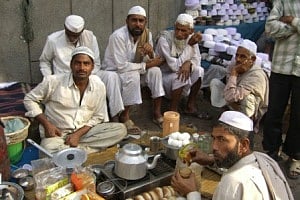
Just a stone's throw from the sedate, tree-lined, high-end New Delhi neighbourhood of Nizamuddin East is a patch of Old Delhi – one of the places along the Jamuna that has seen the longest continuous inhabitation. Take a turn and a dip off the road called Mathura Road, and you are suddenly transported through time, cultures and senses. The lane winds ahead, towards the dargah of the Sufi saint Nizamuddin Aulia. On the left-hand side of a plot cleared of all humanity, standing alone behind some imposing iron bars, is the mazhar of Mirza Ghalib.
Asadullah Beg Khan (Ghalib), the foremost shayar of Urdu, is rather lonely here. All the excitement of this Muslim mohallah is on the outside of the enclave, where the faithful throng on their way to the Nizammudin dargah. With nary a thought for Ghalib, they also ignore the insistent sellers of chadars (offerings for the shrine), caps and posters of the Swiss Alps. Beggars here seek alms in a decidedly jocular manner.
Three cats do give Ghalib company, however, lounging about in the harsh afternoon light. Some plastic bags whirl dervishly about in the breeze. Nearby rises the dusty concrete block that houses the Ghalib Academy, along with its library and the Qami Council for the Promotion of Urdu Language. Further down the lane is Karim's famous Mughlai eatery, where they claim to have been serving succulent kebabs in an unbroken line of ancestry that goes back to the Great Mughal himself. Outside, in the lane, a young chaiwallah boy pours tea – extra strong, extra milky and extra sweet – in tiny, dirty porcelain cups. Ghalib would have liked the tea this boy pours, for sure.
What Ghalib would not have liked is the sign that announces his tomb. It is in white-on-blue Nagari Hindi and Roman English, with Arabic Urdu completely absent: "Inside the marble enclosure lies the grave of the great shayar of Urdu and Persian Mirza Ghalib (1737-1866)…"