
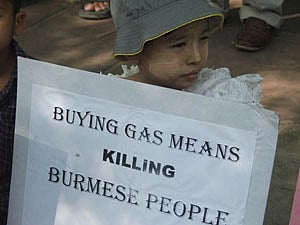
Even as Southasia's energy-strapped, fast-growing economies have led many to wonder whether antagonistic neighbours may be pushed together into forced cooperation, on the eastern edge of the region a less optimistic dynamic is playing out. Indeed, the huge natural-gas reserves of Burma have caused many Asian governments to turn a blind eye to Rangoon's continued oppressive and non-democratic tactics.
Burma stands on the world's tenth largest natural-gas reserves, estimated at more than 90 trillion cubic feet (tcf) in 19 on-shore and three major offshore fields. As the economies of South, Southeast and East Asia have soared upwards in recent years, the Shwe 'gas block' in western Burma's Arakan state has instigated intense competition between India, China, South Korea, Thailand, Japan and Singapore. South Korea's Daewoo International estimates that just two blocks from the Shwe gas field together have a reserve of about 20 tcf, equivalent to about 3.5 billion barrels of oil. There are currently four stakeholders in the Shwe Gas Project – Daewoo (which controls 60 percent), KOGAS of South Korea, and two Indian interests, the Oil and Natural Gas Corp (ONGC) and the Gas Authority of India Limited (GAIL).
India has outlined several options for importing gas from the Shwe field, including three land and three sea routes, besides transporting the product in liquefied or compressed states – LNG or CNG. New Delhi's most preferred option would be to construct a pipeline through Bangladesh to West Bengal (see accompanying story, "Neighbourhood gas"). Intransigence in Dhaka, however, has led to the formation of several preconditions unacceptable to India: a reduction of the Indo-Bangladeshi trade deficit, transit for trade goods to and from Nepal and Bhutan, as well as a guarantee from India to import more Bangladeshi goods. India's difficulty in changing Dhaka's mind on the pipeline project has led to fraying tempers in Rangoon, where junta officials have urged India to look to alternative plans, including setting up electricity-generation projects near the gas fields.
In December 2005, the Indo-Bangladeshi standoff on the matter led Burmese officials to sign a memorandum of understanding with PetroChina, one of China's largest privately owned companies and its second largest power generator. According to the agreement, by March 2006 PetroChina had completed a survey for a 2380 km pipeline from Kyakphu in Burma to China's Yunnan province. As part of the deal, Burma's military regime would have received a USD 84 million soft loan from Beijing. The pipeline would traverse central Burma's 'Dry Zone', hosting over 25 percent of the country's population, and home to some of the country's most pressing humanitarian needs.