
Under the watchful eye of a male instructor, a teenage boy is deep in concentration, trying to render and copy from a postcard as accurately as possible. This has been the art scene in Afghanistan for years: stale and exclusive to males. And, whether in the fine-arts faculties of Kabul and Herat universities or in the handful of private centres around the country, realism has long ruled as the only accepted style; the degree of precision in copying a picture, or occasionally a live model, has been the yardstick with which to judge artists. Now, however, the tide seems to be turning.
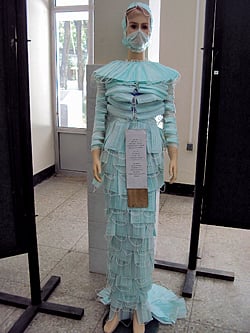
A few months ago, two spacious auditoriums in Kabul University hosted a weeklong exhibition. A range of mediums, including photography, installation, collage, video and sculpture, was employed in the 50 works on display, which explored the theme of environment and pollution. The exhibition was remarkable for two reasons: all 18 participating artists were young women, and the genre was modern art, a rarity in Afghanistan.
'The aim of the exhibition is to make artistic compositions out of everyday objects,' says curator Rahraw Omarzad, also the director of the Centre for Contemporary Arts of Afghanistan (CCAA). 'Our artists explore how we can reuse objects and materials that have been discarded to give them new meaning and reintegrate them into our lives. With this effort, we want to show that reintegration is only achievable with a different, more creative mindset.' While this attempt to infuse creativity and relevance into the Afghan art scene is still in its infancy, there are encouraging signs of growth.
The institutionalisation of art in Afghanistan did not begin until 1921, when the relatively reform-minded King Amanullah Khan founded the first institute for fine arts in Kabul. Thereafter, progress was slow due to political turbulence until the arrival of the communists in the 1970s. Within 15 years thereafter, the three major art institutions that remain in Afghanistan today were set up, the most important being the Maimanagi Centre for Arts in Kabul, which was established in 197l. Then, in 1976, Kabul University became the first academic institution in the country to include an art department; Herat University established one only ten years later.