
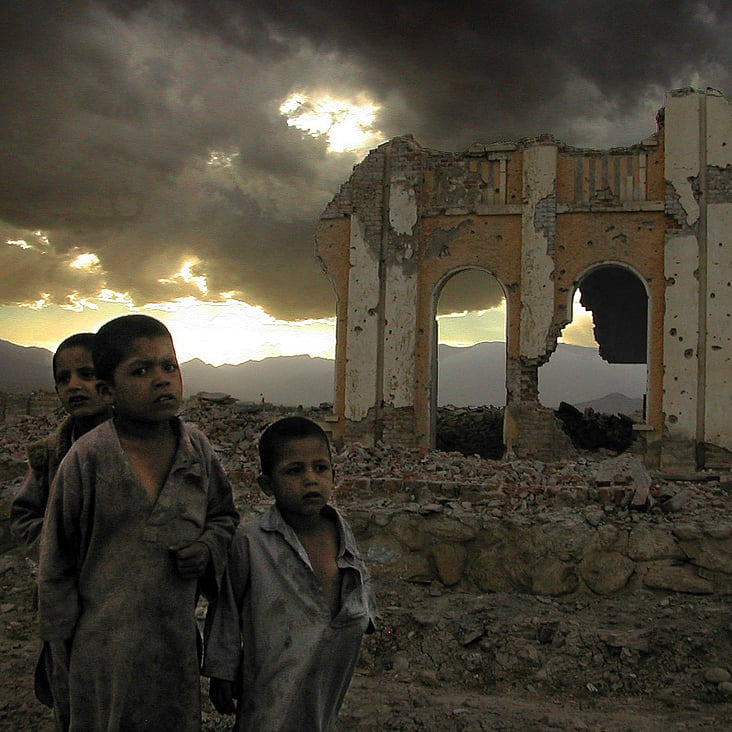
My parents didn't force me to go to the 'other side' of town that morning. I wanted to show them – mostly my father – that I was a grown man. It was 1994, I was ten years old, and a full-scale civil war had been ravaging my country for two years.
The pale sun had barely risen when I left home. It had snowed the night before, and my eyes took a few seconds to adjust to the brightness, even at that hour. Aside from a few stray dogs, the streets were empty. I shivered as a cold wind hit me in the face. I buttoned up my coat and plunged my hands deeper into my pockets, walking as fast as I could towards the bus station.
I recalled the events of the previous day that had prompted me to take this excursion. Over lunch, my father had slapped me and shouted "You son of a dog!" as I chewed on a piece of bread that my mother had baked in the tandoor. My habit of eating messily had angered him, as it often did. I thought about how formal our relationship had always been, and how he never called me 'son', how I never called him 'father'. I hated Burhan, my older brother, because he was my father's favourite. Father likes him because he works and makes money, I thought, or perhaps because he is a man and I am a boy. A wave of hot anger rushed to my head, and despite the cold my face felt as though it was burning. He doesn't beat him because he is a man! I thought. I'll prove that I'm also a man, that I can work, and that I deserve his respect.
My father's friends would come to our house to 'talk politics'. Over steaming cups of green tea and white Russian sugar cubes they argued for hours about ethnic warlords and their territories. Sometimes I sat and listened to them talking about the price of food in our part of Kabul compared to the other side, which was controlled by the opposition militias. Uncle Janan, my favourite amongst father's friends, said that the militias were cutting our food supplies to pressurise the government. He scorned them for calling themselves Muslims while denying us food.