
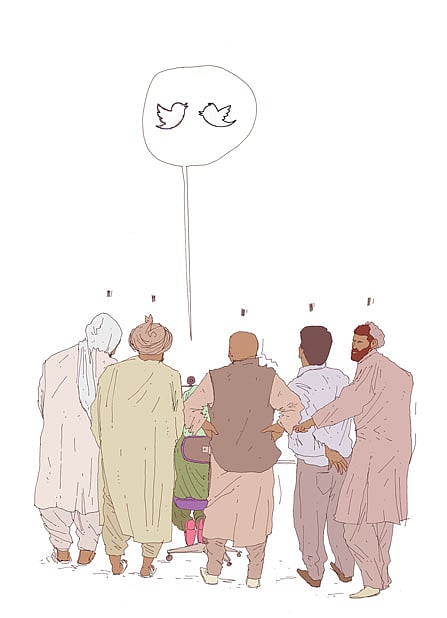
On International Women's Day 2013, a group of women's rights activists in Kabul called Young Women for Change saw no better way to mark the occasion than to open the first female-only internet café in Kabul. Young women needed a place to surf the internet in peace, they argued, without facing the harassment they often endured in regular male-dominated cafés. For the growing numbers of urban, educated youth in Afghanistan, as in most other parts of the world, life without the internet is now unimaginable. Like people everywhere, they use it for entertainment and information; to stay in touch with far-flung friends and family members; to pursue personal projects including education, self-expression and love; and for social activism and political mobilisation. Researchers who study the internet are increasingly coming to terms with the fact that far from being the radical, liberating force that some feared and others celebrated in its early days, the internet can actually be quite conservative: it often reproduces many of the conventional behaviours and social hierarchies that are found offline. But my research on the Afghan diaspora has convinced me that when it is harnessed at a time of intense social flux and transition, as in Afghanistan today, the internet can also have disproportionate cultural and political effects.
Banned under the Taliban, internet use has exploded in Afghanistan in just over a decade, reaching a million users in 2009, and doubling to two million by 2013, according to the Ministry of Communication and Information. While this figure represents just six per cent of a largely illiterate population, projects to close the digital gap are intensifying as a fibre optic network is developed by Chinese investors, with a three-fold drop in price announced in 2013 and further reductions expected. The number of Facebook users in Afghanistan has jumped from 6,000 in 2008 to 470,000 in 2013, and most people get online at internet cafes or via their mobile phones. In fact, my ambitious young friends told me, one of the perks of a good government or international NGO job was reliable, steady access to the internet.
A favourite pastime is sharing images and Youtube video clips on Facebook or via mobile phones, and the commentary under these is often a barometer for public opinion on a variety of topics. People express both national solidarity and hatred and distrust of rival ethnic groups or political factions. They also have heated exchanges about sexual propriety and the public role of women, as evidenced by the commentary about Ariana Saeed, a Swiss-raised pop singer who was the boldest female contestant to date on the hit reality show Afghan Star (the Pop Idol-like televised music competition that has taken the country by storm), appearing in figure-hugging clothes and without a headscarf. The mudslinging was to be expected, but more surprising perhaps was the extent of support for Ariana, with comments to the effect that her talent was what really mattered, and should be a source of pride for all Afghans.
The political impact of the internet is illustrated by the very different treatment of a document of considerable public interest in 1989 and in 2013. In 1989, the government of the then-president Najibullah was seeking to distance itself from the crimes of the early years of the communist regime. It released the names of 11,000 people who had disappeared without a trace, but which it now admitted with 'deep regret' had been killed by the state security agency between 1978 and 1979. The list was handed over in Kabul to the British politician and human rights campaigner Lord Nicholas Bethell. Although Lord Bethell then passed the names on to the Afghan rebel leaders based in Peshawar, the diaspora at the time was fragmented ethnically, geographically and politically, and had limited means of communication. Over subsequent years of political upheaval the list was forgotten and the families of many victims, were left waiting in a cruel limbo for news of their loved ones.