
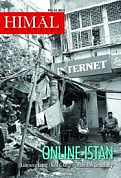
Himal Southasian is delighted to announce the release of our third quarterly 'bookazine' Online-istan. The dramatic changes that Southasians have experienced – and indeed, will experience – as a result of the penetration of Information and Communication Technology throughout the region, inspired Himal's exploration of a notional, unilaterally declared 'Online-istan'.
Packed with thematic features, Online-istan sees Nalaka Gunawardene narrate the journeys of a digital immigrant, whilst Deepak Adhikari looks at the Nepal Wireless Networking Project in Nangi village. Abhishek Choudhary writes on 'marriage 2.0' and the ways in which online dating sites reinforce caste prejudices, as Kyle G Knight explores the creation of queer internet spaces through which safe housing in India has been sourced. Lawrence Liang asks probing questions relating to online identities, arguing paradoxically, that "impersonation (of ourselves) is the closest that we can get to authenticity". Included is an info-graph documenting the state of Southasia's ICT infrastructure, highlighting the current hurdles Southasians face in achieving greater connectivity.
Though the editors are fond of our pioneering print format, the irony of curating a print-only exploration of online Southasia was difficult to escape. In supplementing the thematic content of our bookazine, whilst expanding Online-istan's civic discourse, we are pleased to offer a selection of web-exclusive articles.
The first of these is Kunda Dixit's 'Exiled to Cyberia', a companion piece to his 1998 article (republished in the new print issue) 'Can the Southasian toad leapfrog?', in which he recants his turn-of-the century web skepticism and highlights the revolutionary potential of mobile connectivity. Whilst illustrating the limitless punning potential of the internet, 'Exiled to Cyberia' demonstrates the inherent difficulties in analysing technology as vitally reflexive as the world wide web.