
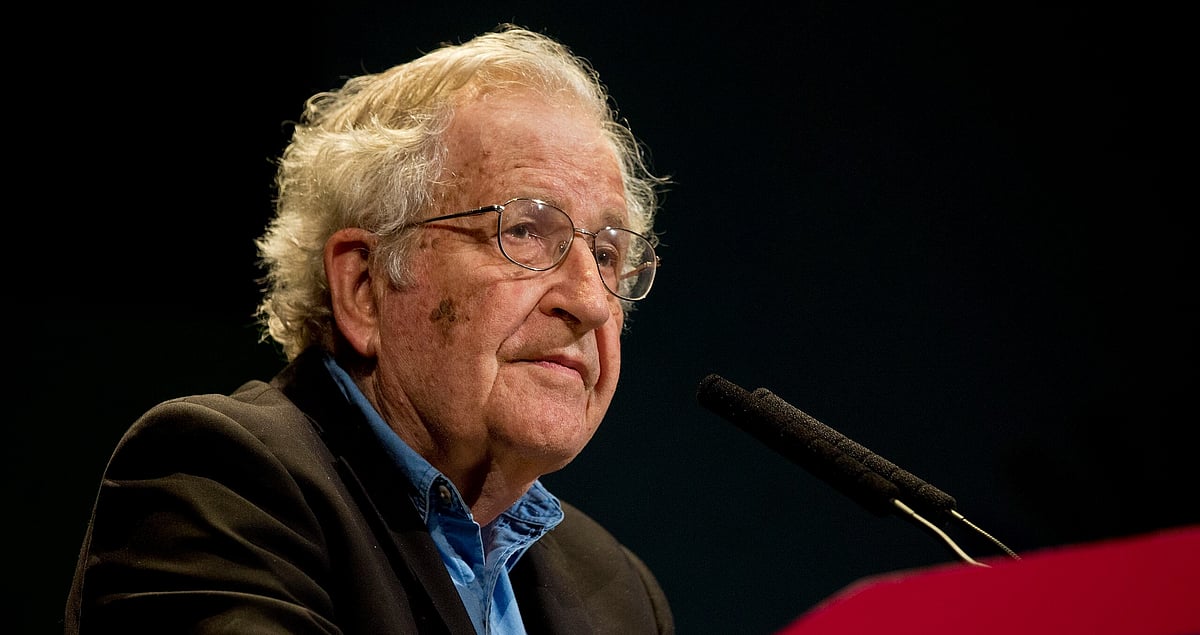
Noam Chomsky says humans are an "endangered species" and given the nature of their institutions, they are likely to destroy themselves in a fairly short time. When Chomsky was in Pakistan in late November 2001 to deliver the Distinguished Eqbal Ahmed Annual Lecture, I asked him about the survival prospects of civilian institutions and society in Pakistan, a 'species' endangered by the institutional hegemony of a pathologically powerful military establishment. With a curiosity unique to his razor sharp mind, Chomsky threw the ball right back at me: "Do you see any glimmer of hope?" In response, 1 inadvertently found myself playing the proverbial prophet of doom.
At the turn of the new millennium, when most countries around the world have more or less accepted democracy as the best possible form of government, Pakistan is still grappling with unending praetorianism. After eleven years of electoral democracy in which power alternated between the Pakistan Peoples Party (PPP) and the Pakistan Muslim League-Nawaz (PML-N) often at the behest of the military, the generals seized direct control in October 1999.
How did Pakistan get here? The roots of praetorianism date back to the early years of Independence when a host of external and internal factors combined to tilt the civil-military institutional equation in favour of the military. For one, a migrant political leadership lacking in a domestic political constituency continually resorted to extra-constitutional tactics to hold on to power. At the same time, the fledgling state prioritized national defence over critical development needs as it faced a hostile neighbourhood. Moreover, weak civilian administrations routinely fell back on the wellorganised military to undertake even day-to-day civilian tasks. This reliance on the military gradually eroded respect for civilian authority among the men in khaki, spurring them to 'save Pakistan' at the slightest sign of political instability. The military ultimately emerged as a domineering vested interest in state and society.
This superimposition of the military on vital aspects of civil and political life over the decades has stripped civilian authority of even its basic functions. Be it federal or provincial administrations, universities, examination boards, public utility corporations, state research institutions, the military has gradually 'taken over' in the name of promoting accountability and reducing corruption. Militarisation is not just limited to the public sector. Name a vital sector of the economy (logistics, public works, fertiliser, cement, sugar production) and the military runs it tax free, clearly undermining any chances of fair competition, besides crowding out scarce investment resources required for private sector development.