
On my way from New Delhi to Chandigarh in May 2015, returning after a short visit to the capital, my bus approached the township of Karnal where police cars and riot-control vehicles had blocked the highway. The Volvo bus was allotted an alternate route, a smaller pathway through decrepit villages; every few minutes the bus would stop at a sharp turn, its bulk making it difficult to turn in a single spin.
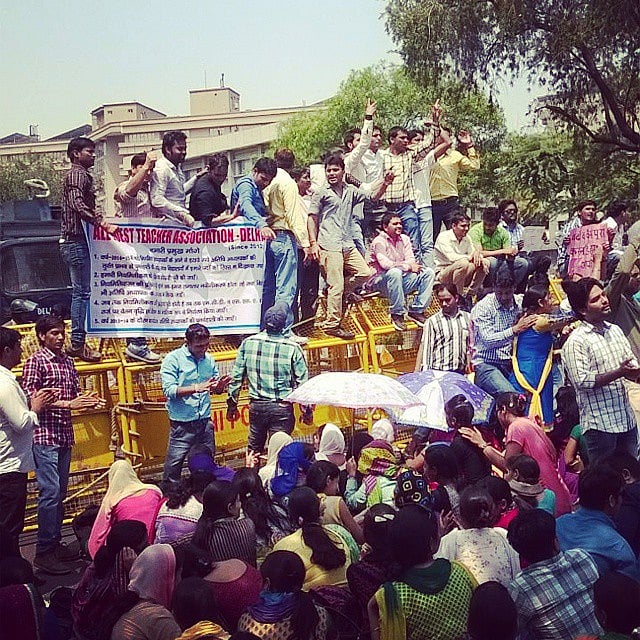
The next day, while browsing for news on the internet, I read about how the blockade was imposed by the police after it clashed with protesting teachers on the Karnal highway. The incident revealed a familiar story and one reported tepidly by India's media. In fact, chronicles of such protests by teachers have now become trifling news. Only, in its first instance, in Karnal, had the protests boiled over and served tabloids with the grist that makes for sharp headlines. Nearly 15,000 teachers, it has been claimed, protested in Karnal, of which almost 100 got themselves tonsured in a desperate attempt to get the attention of the Ministry of Human Resource Development.
The protests in Karnal followed what was a larger, though peaceful, strike in Bihar on 10 April 2015, where an estimated two lakh contract teachers were on strike. Many primary and secondary schools in the state were left in a limbo. In the months following the strikes in Bihar, contract teacher groups have sprung up around the country; their aim was to push the government to regularise contract teacher jobs. In the age of social media, mobilisation has become easier, and there were agitations in Kashmir, West Bengal, Haryana, Chandigarh and New Delhi – a collectivism that is coincidental rather than premeditated.
What has been common in these protests is the demand for regularisation of positions held by contract and guest teachers and implementation of provisions that would bring them on an equal standing with permanent teachers. At present, a contracted teacher teaching primary, or upper-primary is paid between INR 8000 to 11000 (USD 121 to 167) per month, while permanent teachers get thrice that amount and are included in provident fund schemes – as stipulated by the Sixth Pay Commission, implemented in August 2008. The pay commission did not cover contractual labour.