
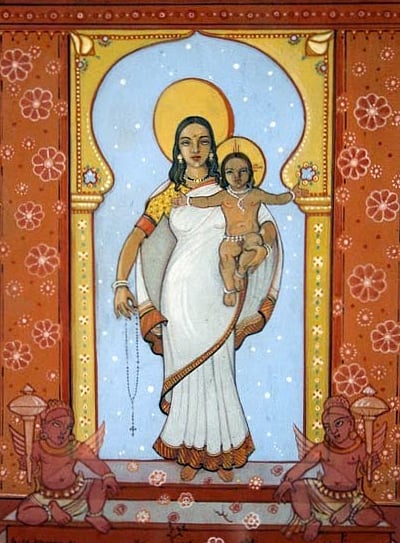
The dusk years of the British Empire threw up a plethora of new aesthetics that have since governed the display of and writing on Indian art. During the latter half of the 19th century, the works of Raja Ravi Varma, a painter from the princely state of Travancore, began to focus on visualising mythological themes, albeit rendered in the styles of Western academic art. Some decades later, Amrita Sher-gil used the flourishing strokes of the cave painters of Ajanta to deal with contemporary themes, while Jamini Roy's Adivasi and folk renditions co-opted diverse visual styles into contemporary art. Around the same time, from the mid-1930s to the 1960s, Angelo da Fonseca, a Goan artist housed at the Kristi Prema Seva Ashram, an Anglican institution in Poona founded to promote dialogue between cultures, was trying to give a new 'visual lexicon' to Christian art. In this, he was particularly exploring how to allow Christian art to absorb the cultural languages of the Subcontinent – a link truncated, possibly even irretrievably lost, to the exigencies of the colonial situation.
In Goa, at the time a tiny Iberian colony, a spectrum of changes was bringing a new political ethos to the landscape. Elite families had been working as agents for the colonial power while still keeping the broadened roots of their identities intact; many were slowly beginning, for instance, to shed their ballroom dresses and embrace khadi – a new nationalism that began to spread to several families across the social stratum, including that of Angelo da Fonseca. Born in December 1902, Angelo hailed from an elite family of Santo Estevam, an island village near Panjim, where the family owned huge estates and held some lucrative political posts in the colonial administration. His choice to be an artist was a premeditated one, though secured at great odds.
Like most Goan sons of the time, da Fonseca had three career paths to follow: doctor, priest or lawyer. Dutifully, da Fonseca began down the road to becoming a doctor, but quit after just a year of studies, moving to Shantiniketan in West Bengal. 'I wanted to be a shisya of the best Indian artist in the twenties of this century, Abanindranath Tagore', he later wrote in an essay. Though Tagore did not teach at Shantiniketan, he did mentor promising art students there, and da Fonseca's proximity to the Tagore clan is evidenced in a number of his early sketches of various members of the family.
According to one possibly apocryphal story, Tagore is said to have told da Fonseca after a 1934 exhibition of his work in Calcutta, 'Go back, young man, and paint churches!' Indeed, da Fonseca appears to have taken this advice seriously, for his subsequent body of work, including his writings, reveal an attempt to root Christian imagery in local culture and art traditions. In so doing, he also attempted counter the feeling that Christianity was a 'foreign' religion.