
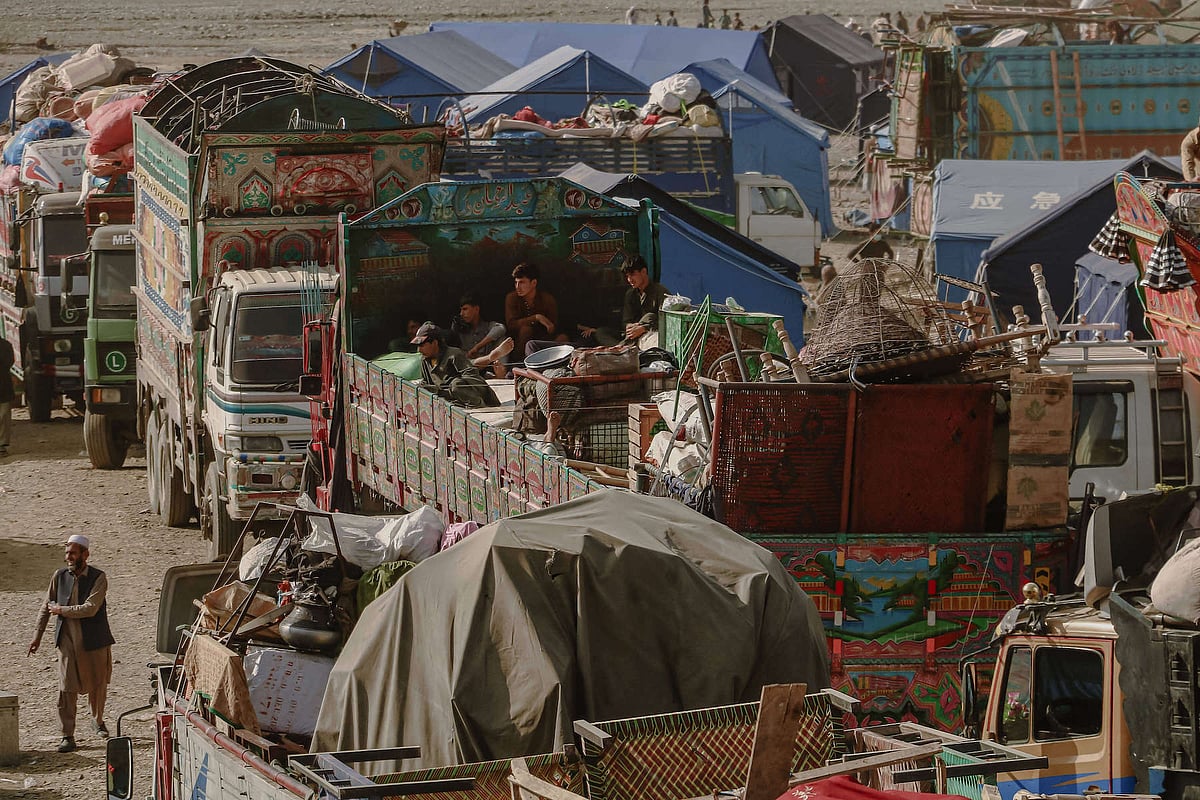
On the grey afternoon of 1 November, two buses carrying undocumented Afghan migrants pulled up in front of a beige block in an unoccupied housing colony on the outskirts of Peshawar with a police escort. Their arrival set off a commotion as officials and media personnel rushed towards the vehicles, and a media scrum surrounded an official who emerged from one of the escort cars. Inside the bus, the migrants watched on unmoved with weary faces. They were just out of Peshawar's central jail, where they were being held for entering Pakistan illegally or overstaying their visas, and had been rushed to a hurriedly set up processing zone at the colony before deportation to their homeland. The Pakistan government's deadline for undocumented migrants to leave the country voluntarily or face detention and deportation had just passed on 31 October. The processing centre, one of three in the northwest of Pakistan, was still being readied to hold migrants before they were sent to Afghanistan. Workers could still be seen rigging up generators and fixing the water supply.
About half an hour after the buses arrived, authorities started to process the migrants for deportation. They disembarked from the buses in pairs and were taken to officials of the Federal Investigation Agency in a ground-floor room, then to a van with biometric equipment operated by the National Database and Registration Authority. After they emerged, each with a piece of paper in hand, they were taken to a nearby police truck, which was to take them to the Torkham border crossing, roughly fifty kilometres to the west.
Zakirullah, aged 27 and from the Khogyani area near the Afghan city of Jalalabad, another 75 kilometres or so beyond the border, was among those being deported that day. He had spent several weeks behind bars. Zakir used to sell vegetables from a pushcart on the outskirts of Peshawar until he was arrested and had spent several weeks behind bars. The Afghans pulled from the prison that day were showered and garlanded with marigold flowers and offered sweets before they were put on the buses that brought them to the processing centre – a perverse gesture, usually reserved for happy occasions, presumably meant to celebrate their journey home even though the migrants themselves were in no mood to celebrate.
Zakir was simultaneously teary-eyed and angry as he awaited the trip to the border. "We were really treated badly in jail and I will not forget it," he said. I pushed him for details of what had happened, but he would only say, "It was really harsh." Zakir said he had planned to eventually make his way to Türkiye and then sneak into Europe, but the Pakistan government's crackdown on Afghan migrants had disrupted his plans."I have no plans to return to Pakistan after going through all this and maltreatment at jail," he said.