
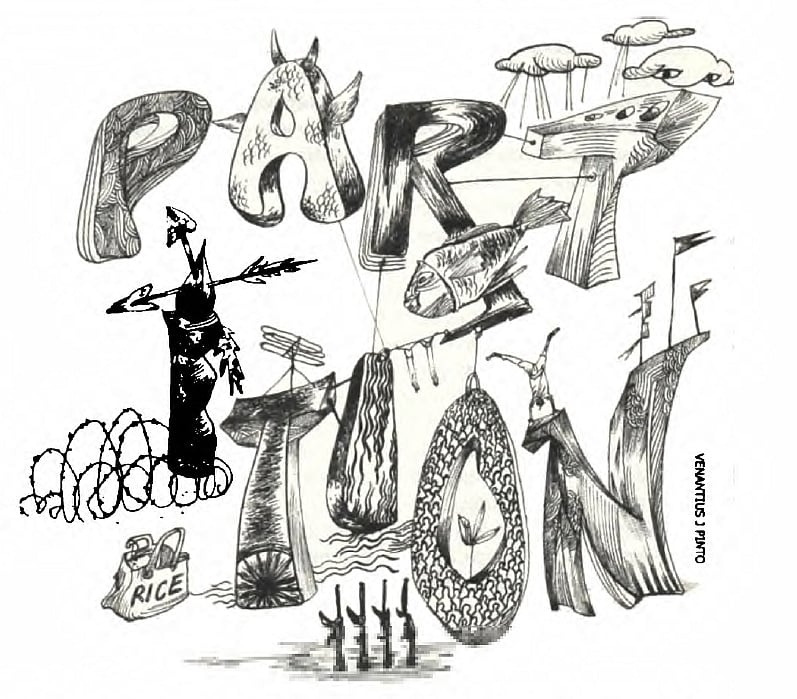
In Southasia, any discussion about partitions immediately conjures up the Great Partition of 1947, as well as the grand narratives of Independence that came to answer the questions, What is India? and What is Pakistan? Partition drew bloody borders that divided sovereignty, and produced a regional system that pitted one state against the other, steadily ratcheting up to a nuclear standoff. Think 'Partition', and it raises the spectre of the 'de-imperialising' will to divide and quit, of the 'guilty men' who 'decided the destiny of millions without their mandate'. Mention Partition, and it instantly recalls narratives of suffering and betrayal, of the forcible dislocation and disruption of the lives of millions of individuals caught in the vortex of the violent creation of two historic national destinies. Look at the policies of Partition, and what comes to mind is the unresolved 'minority' question, as well as the production of a nation in turmoil, as the Pakistan movement implanted itself in a multinational landscape.
The associated assumption here, then, is that Partition in the collective Southasian memory represents the failure of different communities to live peacefully together. Partition's anxieties and dynamics defined our past, and continue to shape and threaten our contemporary socio-political relations. Consequently, it can come as a shock when such complacent sets of assumptions about 1947 are overturned, as some Southasian scholars are currently attempting to do. Several such attempts came this past March in Kathmandu, at a regional consultation called "A Human Rights and Peace Audit of Partitions as a Method of Conflict Resolution".
The suggestion is that perhaps Partition has overly coloured the Southasian imagining of partitions in general – solidifying the idea only of a particular kind of violent and malignant process, and of its extremely negative legacy. One such scholar, the Oxford-based Pritam Singh, shaking off memories of the bloody vivisection of Punjab, has drawn attention to the significance of the essential process of partition – ie, of 'peaceful' partitions – and of aftermaths not characterised by pathological anxieties.
Some recent examples of 'peaceful partitions include the separation of the Czech republic from Slovakia, and Singapore from the Malaysian federation, though these were located within very specific contexts. More of an intellectual teaser is the contra-factual speculation about the secession of East Pakistan and the emergence of Bangladesh. The Pakistani scholar feminist Nighat Said Khan argues that if the Pakistan military establishment had accepted East Pakistan's separation, this would have had the makings of a 'peaceful' partition. Implicit in this proposition, is the assumption of political scientists that partition 'works' when territorially focused social units are sufficiently distinct, and populations can be separated.