
Memories and Movements: Borders and Communities in Banni, Kutch, Gujarat
Rita Kothari
Orient Black Swan, 2013
In late January 2014, Nido Taniam, a young college student from Arunachal Pradesh, was beaten to death in Delhi for protesting against racism. Unfortunately, his death only served to highlight the brutal discrimination faced by many people from India's Northeast who live outside their home states. Communities living on the periphery – literally and metaphorically – of mainstream Indian society often find that there is no cultural space for their 'differentness'. In this context, Rita Kothari's Memories and Movements: Borders and Communities in Banni, Kutch, Gujarat makes a valuable contribution to our ongoing understanding of the numerous regions and peoples that together make up the mosaic that is India.
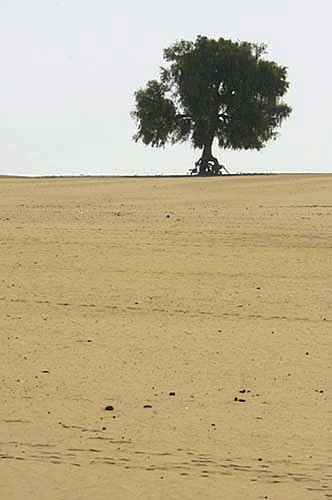
Memories and Movements is the story of Banni, a desert region in the northwestern corner of India, and its peoples. Once made up of grassy pastures but now mostly an arid desert, Banni lies on the Indo-Pak border, to the west of Kutch – the largest district of Gujarat. If Kutch is culturally distinct from Gujarat, Banni is also, in many respects, very different from the rest of Kutch. This is one place that Kothari's work departs from the conventional, interrupting the idea of Gujarat as a "linguistically, culturally and politically cohesive territory with bounded citizenship." The Sindhi-speaking communities inhabiting Banni are several: Muslim maaldharis or semi-nomadic herdsmen; the Dalit Meghwals; and the Wadhas, an even more marginalised community, who have lived for centuries on the edges of both Hinduism and Islam. These communities are different from the "urban, modernizing, entrepreneurial drive" of predominantly Hindu Gujarat in several respects. They are pastoral and semi-nomadic Muslim and Dalit communities that claim greater cultural sustenance from Sindh, now in the 'enemy country' Pakistan, than from their 'home state' of Gujarat.
Paradoxical region
An anthropological study of Banni and its peoples, Memories and Movements has been crafted out of Kothari's interviews and interactions with its peoples over several years, as well as primary and secondary literature in English, Hindi, Gujarati and Sindhi. Kothari's work introduces the reader to a different way of looking at this region: not as a part of the larger state of Gujarat, but as a cultural extension of what could possibly be termed the Thar Desert region, including the Rann of Kutch and Banni. Although the desert is conventionally viewed as a 'natural' border area in both India and Pakistan, or even an empty 'wasteland', the Thar Desert – covering parts of Gujarat and Rajasthan in India, and Sindh and Punjab in Pakistan – is a cultural region in and of itself. As Kothari points out: