
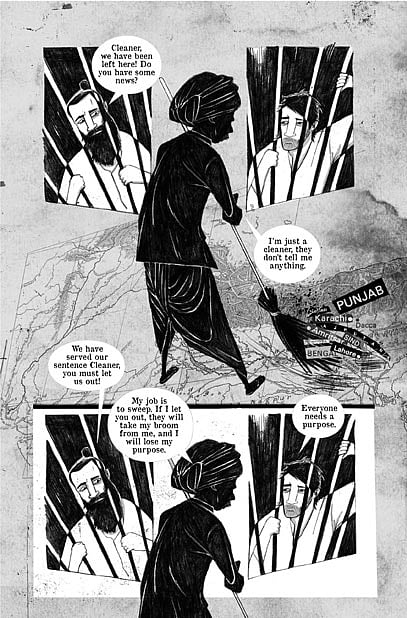
'This Side, That Side: Restorying Partition, Graphic narratives from Pakistan, India, Bangladesh', curated by Vishwajyoti Gosh, Delhi: Yoda Press, 2013.
"Come to the house. Not the theatre," he said on the phone. It was 1994. My granduncle, Inder Dass, and I had a regular lunch date at the Little Theatre near Mandi House in New Delhi. Why, I asked? It took some time for him to admit this to me, but he had become addicted to Oprah's show. It ran around lunchtime. "She makes people say things I don't allow myself to think," he said once in a moment of weakness.
My granduncle and I shared a love for stories. He liked to tell me about his youth and about his early days as a playwright. We often discussed one of his favorite plays, the last he did in Lahore in the waning days of its cosmopolitan colonial glory – Society ke Thekedar, the 'Contractors of Society' (1946). Angry at the countdown to Partition, Inder Dass decided to skewer the political leadership. They were going to sell out his world, compel him to leave what he knew and loved. He reconstructed the play for me so many times I feel that I might even be able to write it down. I'm not sure if there is a copy of the play anywhere, but that became beside the point.
Everything changed the day that Inder Dass talked about his brother. We come from a large Punjabi family, where all the aunts and uncles are not only accounted for but so are their progeny and wider families. Now he sprang upon me another uncle. Sometime in 1946, as Inder Dass was working on his play, his younger brother failed his school exams. Foreboding was the ethic of the land, and concentration on studies could not have been easy. The brother had a nervous breakdown. He hid in his room.