
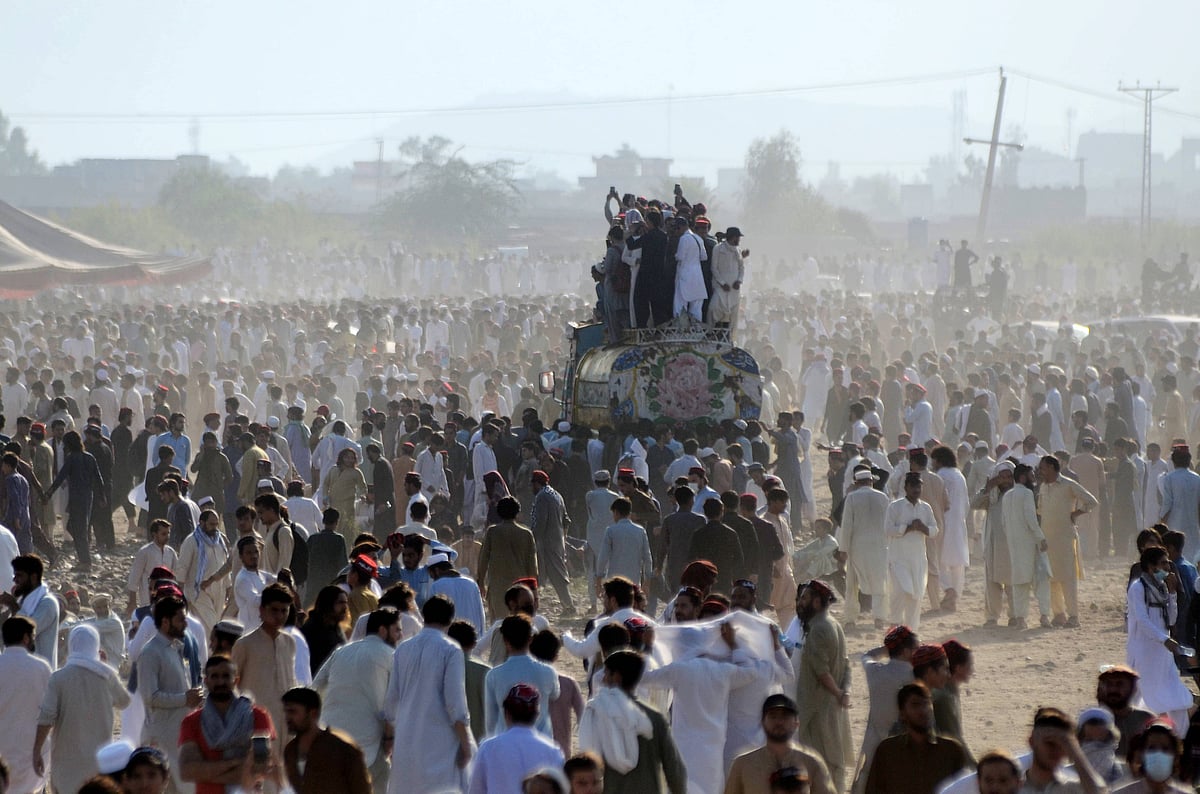
Hazrat Naeem Wazir, better known as Gilaman Wazir, would post his evocative poetry about Pashtun rights on Facebook, where it would be widely shared. He was often seen at gatherings of the Pashtun Tahafuz Movement (PTM), where his sing-song voice was heard advocating for Pashtun rights. Wazir was very close to Manzoor Pashteen, the leader of the PTM, and the two would often be seen together in public. Unsurprisingly, this made him a target.
In 2020, Wazir was arrested in Bahrain, where he was working, and deported to Pakistan. This July, he was attacked by a group of armed men in Islamabad, and later succumbed to his injuries in hospital. The fact that his killers were able to evade justice raised many questions; the police said they would investigate the killing but never made any arrests, as PTM members have repeatedly pointed out. Soon after Wazir’s death, Pashteen announced a Pashtun Qaumi Jirga, or Pashtun National Court, to be held in three months. On the agenda was a demand to end violence against Pashtuns by the Pakistan state and Islamist militant groups, and a push to define a future course of action for the Pashtun community.
Pashteen’s announcement of the upcoming jirga appeared to cause alarm among government circles. On 6 October, Pakistan’s government banned the PTM, with a government circular claiming that the movement had “engaged in certain activities which are prejudicial to the peace and security of the country.” The move appeared to be a bid to prevent the PTM from holding the jirga, scheduled to begin on 11 October in Khyber Pakhtunkhwah, a region which has seen multiple military operations and militancy. The area, and in particular Khyber Pass, is also historically significant as it opens into Afghanistan and was used by the Macedonian king Alexander the Great, the Afghans and the Mughals to conquer India. The PTM’s choice of Jamrud, a town close to the Khyber Pass, as a location for the jirga was seen as particularly significant.
The circular and ensuing crackdown on PTM activists and supporters – including a ban on government employees attending the jirga – failed to achieve its objective. Instead, a crowd of supporters including the organisers gathered, signalling their intent to go ahead with the event. On 9 October, police opened fire on the organisers, with three killed and at least 10 injured. The next day, the chief minister of Khyber Pakhtunkhwah province, Ali Amin Gandapur, hosted a meeting with representatives of several political parties. Under pressure, the federal government agreed to temporarily rescind the ban as the PTM activists made it clear that they would not budge from their positions despite the violence. Gandapur was tasked with acting as an intermediary between the political parties and the PTM and to facilitate the jirga to be held peacefully with a couple of caveats; there were to be no “inflammatory” slogans chanted against the government during the jirga, and there could be no waving of the Afghan flag. Despite the uncertainty due to the ban, the jirga went ahead. As the event progressed it became clear that the PTM was moving in interesting new directions.