
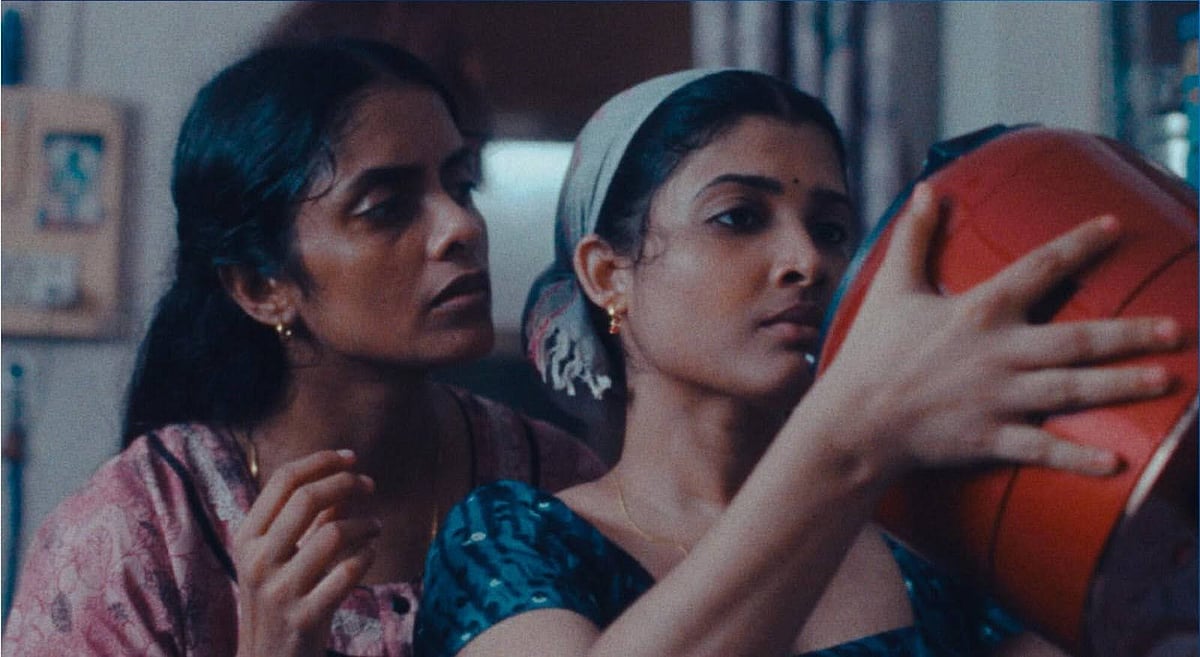
THE MALAYALI NURSE is a ubiquitous figure in India – and, with patterns of global labour migration in the past few decades, increasingly also across the globe. In All We Imagine as Light, the screenwriter and director Payal Kapadia shows us the human beings behind the uniforms and tells us their stories. Kapadia’s debut fiction feature – and the first Indian film to win the Grand Prix at the Cannes Film Festival, taking the honour earlier this year – All We Imagine as Light travels beyond the confines of the two lead characters’ workplace to take us through their personal journeys in a much wider sense.
Prabha, played by Kani Kusruti, and Anu, played by Divya Prabha, have moved from their home state of Kerala in southern India to the city of Mumbai in the western Indian state of Maharashtra. They are flatmates and employed as nurses at the same hospital. Early on, Prabha learns that Anu has become a subject of gossip among their co-workers because she is in love with a boy. And not just any boy – Shiaz, played by Hridhu Haroon, is a Muslim.
In an India riven by prejudice, the combination of Islamophobia with patriarchy’s proprietorial attitude towards – and infantilisation of – women has long manifested itself as a generalised suspicion of Muslim men. The phenomenon has even been given a name: “love jihad”, a term used to describe the right-wing conspiracy theory that Muslim men are wooing, seducing and marrying gullible Hindu women with the aim of converting them to Islam. Given this context, it is easy to understand why Anu wishes to keep her affair with Shiaz a secret.
Anu’s clandestine inter-community romance is just one of the primary relationships that form the film’s narrative. The others are Prabha’s bond with a middle-aged Maharashtrian colleague called Parvati, played by Chhaya Kadam, who is losing her home to a real-estate developer; and the seeming incompatibility between Prabha and Anu themselves.