
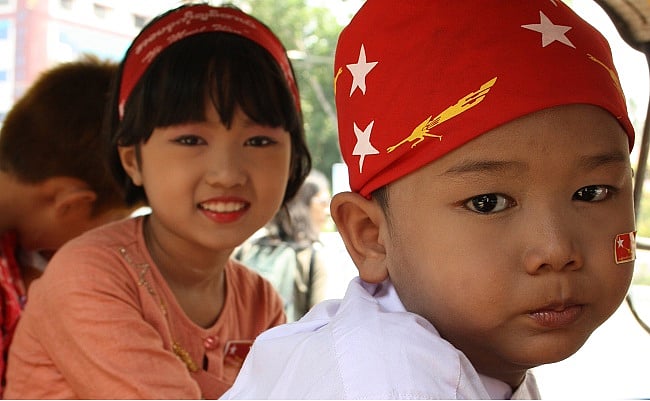
The fighting peacock is flying over Rangoon. As Burma goes to the polls for its first election with the participation of the National League for Democracy (NLD) since 1990, the party's symbol is everywhere in Burma's former capital. Hundreds of cars have been transporting NLD supporters through the streets of the city. Dressed in white shirts and the traditional longyi, the majority are young people, their faces covered with NLD stickers, singing the party song: 'Daw Aung San Suu Kyi is back, the time has come, we must win.' The people on the streets applaud them, and even some prisoners being transported in a police van join in the fervour. '22 years later, our time has come. I'm confident we will win this election,' says enthusiastic 77-year-old U Htun Oo, one of the veteran NLD members who contested and won the 1990 polls before the military regime decided to cancel them.
This Sunday's by-elections, however, are only for 45 of Burma's 600 parliamentary seats, and do not threaten the hold of the regime's Union State and Development Party (USDP). Furthermore, 25% of the seats are reserved for the military. The NLD has showed its concern over some irregularities: the names of some dead people were found on the voter rolls, the boundaries of some constituencies have been changed, and a part of Aung San Suu Kyi's speech on TV was censored. The government has authorised electoral observers from the EU, US and ASEAN to monitor the polls, but the NLD is critical. 'These are not fair elections,' Suu Kyi said on Friday. It doesn't appear, though, that the government's tactics include preventing Suu Kyi's election. '[The government] would be a fool to do so,' says a local journalist who did not want to be named. The government is counting on the easing of U.S. economic sanctions against it following steps towards democratisation, and these elections are key to that goal. The ruling party hopes that the lifting of sanctions will bring significant investment into Burma.
The Burmese economy is the key to understanding recent changes. Some hope that reforms and economic liberalisation will improve the situation of one of the world's poorest countries. 'Remove sanctions and watch Myanmar flourish,' the economist Joseph Stiglitz recently argued. 'Opening up trade in agriculture and textiles…would probably benefit directly the poor farmers who make up 70% of the population, as well as create new jobs,' he added. Stiglitz also observed that 'restrictions that prevent socially responsible companies based in advanced industrial countries from doing business in Burma have left the field open to less scrupulous firms.' However, some NGOs fear that foreign investment without proper labour laws would be dangerous for Burmese workers. During the 1990's, the French oil company Total was accused of using forced labour.
Another crucial issue is the change underway in Burma's relationship to its big neighbour, China. Twenty years of western sanctions transformed Burma into a China-dependent economy. But President Thein Sein recently cancelled a highly controversial Chinese dam project on the Irrawaddy river, in a gesture that was seen as a first step towards a new balance of power.