
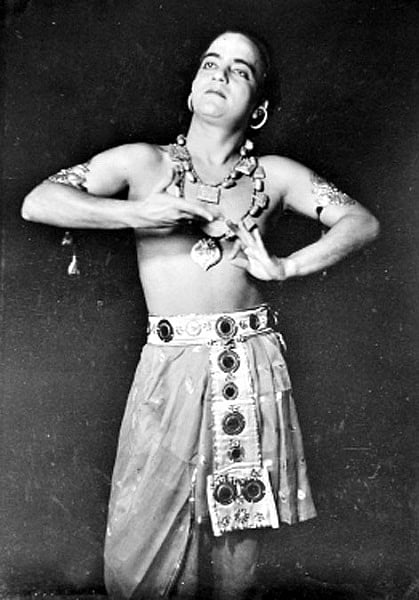
Bulbul Chowdhury was a Bengali Muslim dancer who rose to fame in the 1930s and was later claimed and celebrated, first by Pakistan and posthumously by Bangladesh, as a pioneer of modern dance. Even today he is praised for his striking choreographies (none of which are available in the public domain) and celebrated at the various cultural centres established in his name – most notably the Bulbul Academy of Fine Arts in Dhaka. Missing from these official accolades is any mention of his politics. But the few who knew him well and have since written about him, including his wife Afroza Bulbul, note that Bulbul's creative endeavours were always inspired by a compulsion to challenge identity politics and bring to light injustices. Even though various national projects have depoliticised his life and work by focusing solely on his creative side, Bulbul's politics arguably drove much of his creative expression.
Bulbul's role in the language movement, his political views and his acts of subversion have been all but forgotten.
Before he became Bulbul, he was Rashid Ahmed Chowdhury, born on 1 January 1919 into a Muslim family in the village of Chunati (in what is now Lohagara Upazila, Chittagong, Bangladesh) Rashid developed a penchant for dancing very early in his life – though it was unheard of at the time for children of the 'respectable' upper classes or bhadralok to partake in activities such as music and dance – even choreographing and performing a Chatak dance at a school function. Rashid knew that the conservative restraints of society would be detrimental to his family if he continued to perform, but moving to Calcutta in 1934 to study at Presidency College gave fresh impetus to his passion. He became acquainted with dancers such as Uday Shankar and Sadhana Bose, who, impressed by his talent, invited him to perform with them. In 1936, 'Bulbul' Chowdhury shot to fame following a performance of Rabindranath Tagore's Kach O Devajani with Sadhana Bose. The new moniker was adopted avoid any backlash from conservative Muslim groups and as a means of keeping his identity religiously ambiguous. Thus began an illustrious career during which Bulbul choreographed and performed many iconic dance dramas in India, Pakistan and a number of countries in Europe. He also wrote stories, established several dance troupes and the Calcutta Cultural Centre.
Yet, all these innovations that opened up a space for dance – through their inclusion of an air of respectability – were taking place within a predominantly Hindu framework from which the Muslim society remained excluded. Indeed, as Sitara Thobani discusses in her book Indian Classical Dance and the Making of Postcolonial National Identities: Dancing on Empire's Stage, the projection of these classical dance forms as a part of 'Hindu' heritage further pushed the Muslim society to reject them altogether. This posed a particular dilemma for Bengali Muslims, who struggled to reconcile the two components of their identity that were being framed as contradictory. As Joya Chatterji notes: the "Bengali Muslim identity [was] thus commonly perceived as being riven by a fault line, with Bengaliness and Muslimness co-existing uneasily on the opposite sides of a deep and fundamental divide".