
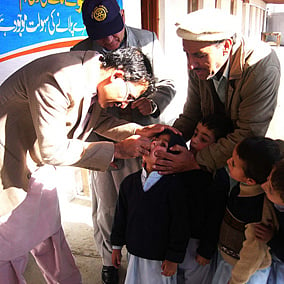
Completing three years of eradicating the poliomyelitis disease that at one point plagued the entire country, India achieved a historic global health victory. In late March, the country received polio-free certification from the World Health Organization, a rare success story in a region that contains two of the remaining three polio endemic countries.
In 2009, India recorded 741 cases of polio, the world's highest number of cases that year. By 2010, cases had drastically dropped to 42, and the last case of polio in India was recorded on 13 January 2011 in West Bengal. By contrast, Pakistan recorded 198 cases of polio that year, the highest in the world at the time.
In 1988, wild poliovirus (WPV) remained endemic in 125 countries, paralysing more than 350,000 children every year. In response to a global health emergency, the Global Polio Eradication Initiative was launched under the WHO to address and eradicate polio. As a result, in 2011, 620 cases were recorded in 16 countries. Through concerted efforts by the international health community, national governments and private donors, today polio remains endemic in only three countries – Afghanistan, Pakistan and Nigeria.
While these three countries pose serious concerns for the health community, the world has seen unparalleled success in eliminating certain strains of the potentially fatal disease. Wild poliovirus type 2 (WPV2) was eliminated in October 1999, with the last case recorded in Aligarh, Uttar Pradesh in India, once an epicentre of the poliovirus. Today, all current cases of polio fall within the WPV1 category, the remaining and most commonly detected strain of polio that causes one case in every 200 infections. WPV3 is a more deadly strain related to approximately one in every 2000 infections, but despite causing fewer cases, can transmit widely and go undetected for a longer period. The last known WPV3 case in Asia was recorded in Bara Tehsil, Khyber Agency in Pakistan's Federally Administered Tribal Areas (FATA) on 18 April 2012.