
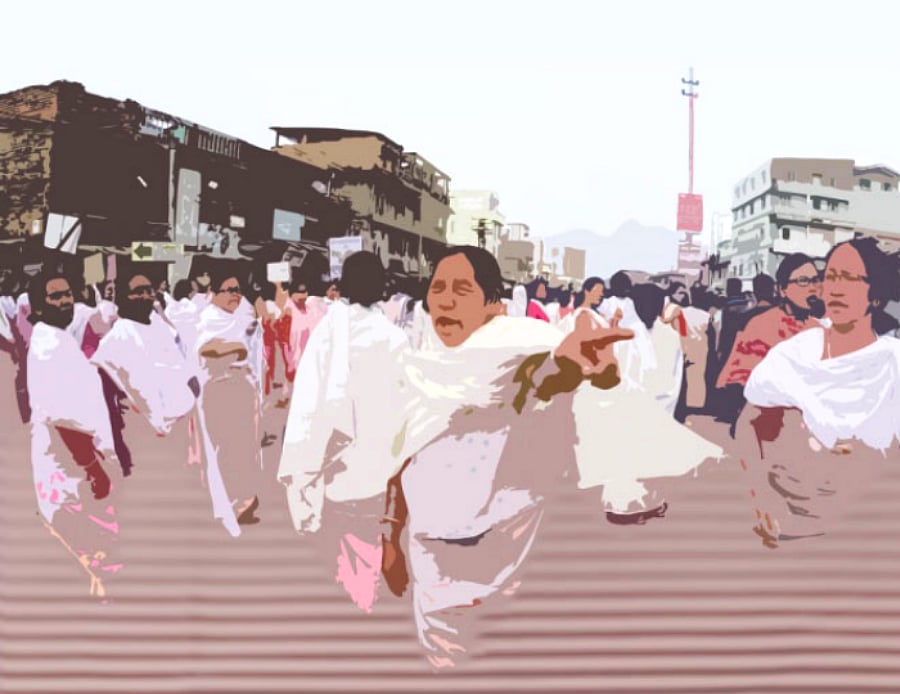
Two little girls run and play in the courtyard. It's clear they are still learning to wear the phanek, the traditional women's sarong-like garment that is wrapped at the waist and falls neatly to the ankles. One of the girls struggles to keep it tied. As they remain cheerfully immersed in their play, there is a loud sound of firecrackers somewhere nearby and they say, "bomb blast."
The opening scene of the documentary film Bloody Phanek by Sonia Nepram instantly captures the attention of the audience, particularly of those who are from the frontier state of Manipur in India. What is poignant about the scene is the interpretation of the sound of the firecracker as a 'bomb blast' by the two little girls. It reveals the political climate of a region torn apart by a conflict that has often been ignored by the Indian political establishment for more than seven decades. The disruption of the girls' play is the everyday disruption of the lives of people who have survived state-sponsored violence under the shadow of the Armed Forces (Special Powers) Act (AFSPA).
The subjects in the documentary film talk about the moment of elation when they first get to wear or own a phanek. This is a feeling to be cherished, until it is smashed by the discovery of the phanek's 'impurity' and 'polluting' nature. At this time, a girl learns that this women's cloth is no longer what she thinks it is. The cloth is now an object of men's disgust that should not be washed or left together with men's clothes. It is not to be hung in the front courtyard where it is visible to the men of the family when they leave the house for work, because it will bring them bad luck.
Bloody Phanek is an immensely personal and political film. It premiered in South Korea at the ninth DMZ International Documentary Film Festival in 2017. In the film, the director frequently appears to search for the meaning of phanek, especially how it is perceived as both profane and sacred. The film resonates with the social and political realities of Manipur, where Indian military occupation and persistent state violence has become both omnipresent and banal.