
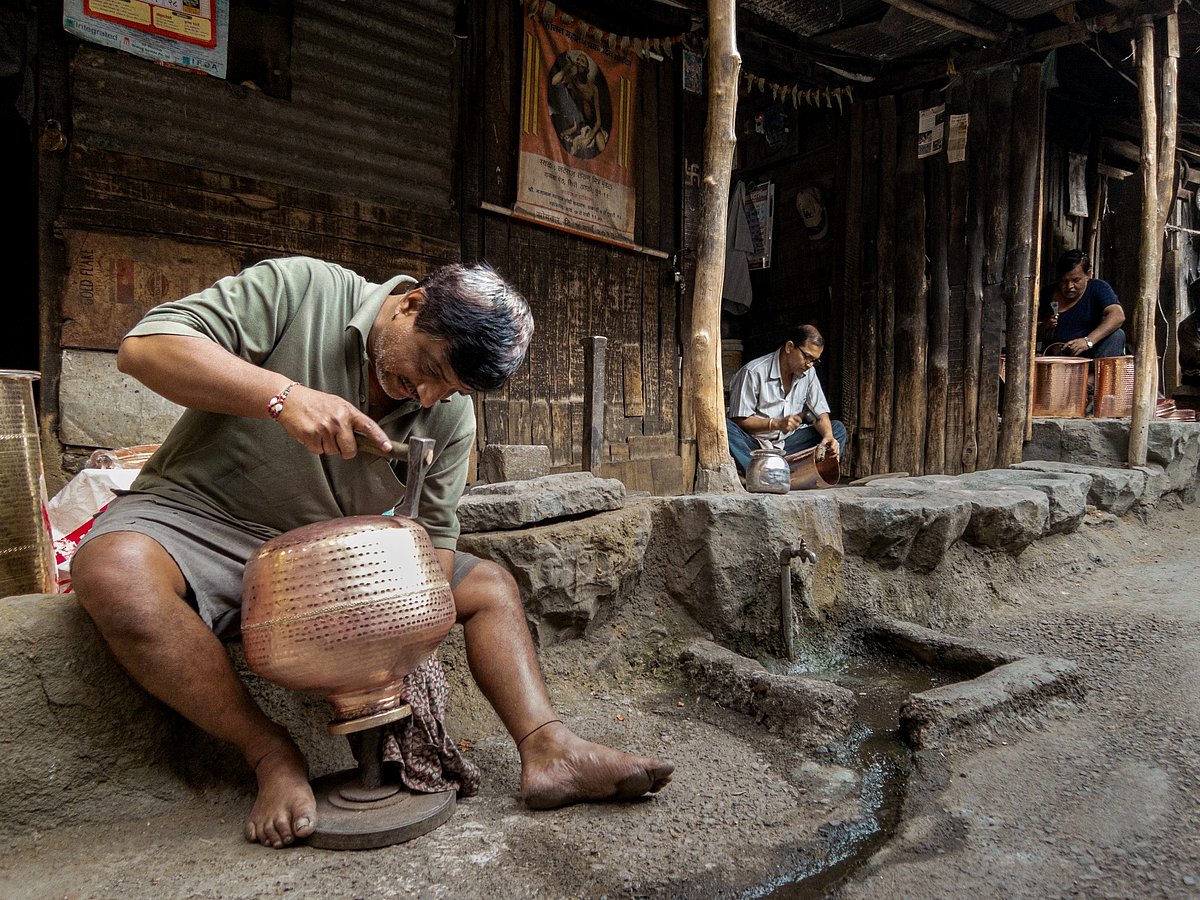
In the old lanes of Tambat Ali, a community of copper workers or 'tambats' have been crafting copper and brass from the time of the Peshwa's reign. As recently as a decade ago, there were many more coppersmiths working in the Tambat Ali area of Kasba Peth, Pune, which now faces a stark shortage of craftspeople. The workshops that once resonated with the sound of hundreds of hammers, now see far fewer artisans plying their trade; so much so that larger orders can scarcely be fulfilled.
Walking around Tambat Ali, people are struck by the history and materiality that the objects carry with them. Some of the tools and equipment used by the artisans are over 50 years old. From the point of shaping copper sheets into the desired shape, to its finishing, polishing and lacquering – the artisans' tools are indispensable to them. Among these is the khod kharwai, the copper artisans' primary tool, which is a wooden seat with a long cast iron shaper that helps to give each piece its signature hand-beaten detail. This is a trademark tool, passed down the generations, and continues to be used without replacement.
Mathar kaam or beaten work, is the distinguishing feature of the tambat craft. While machines have taken over the shaping and polishing process over the years, the signature hammer-tone texture and finish can only be achieved by hand. Hand-beaten depressions strengthen the vessel and enhance its surface by giving it a mirror-like appearance. This artistry and techniques are still safe from the onslaught of mechanisation. This work is also done on old copper vessels and utensils to give them a new lease of life, making it a practice in sustainability.
In order to ensure that the craft is kept alive, the artisans are willing to dedicate their time to training younger generations. While they believe that the inherited skill may be picked up in a few days, they also know that it takes years of dedication to become a skilled karigar or artisan. Practice and patience are prerequisites, for it is a precise craft perfected with time. This is often a deterring factor for the younger generation, resulting in the fast-dwindling number of karigars over the years. Some artisans also say they would rather have their children pursue other professions than follow in their footsteps due to the diminishing earnings from the trade. The increasingly unsteady demands have resulted in fluctuating incomes, and when the effort put in is weighed against returns from the trade, very few young apprentices are willing to dedicate themselves to it.