
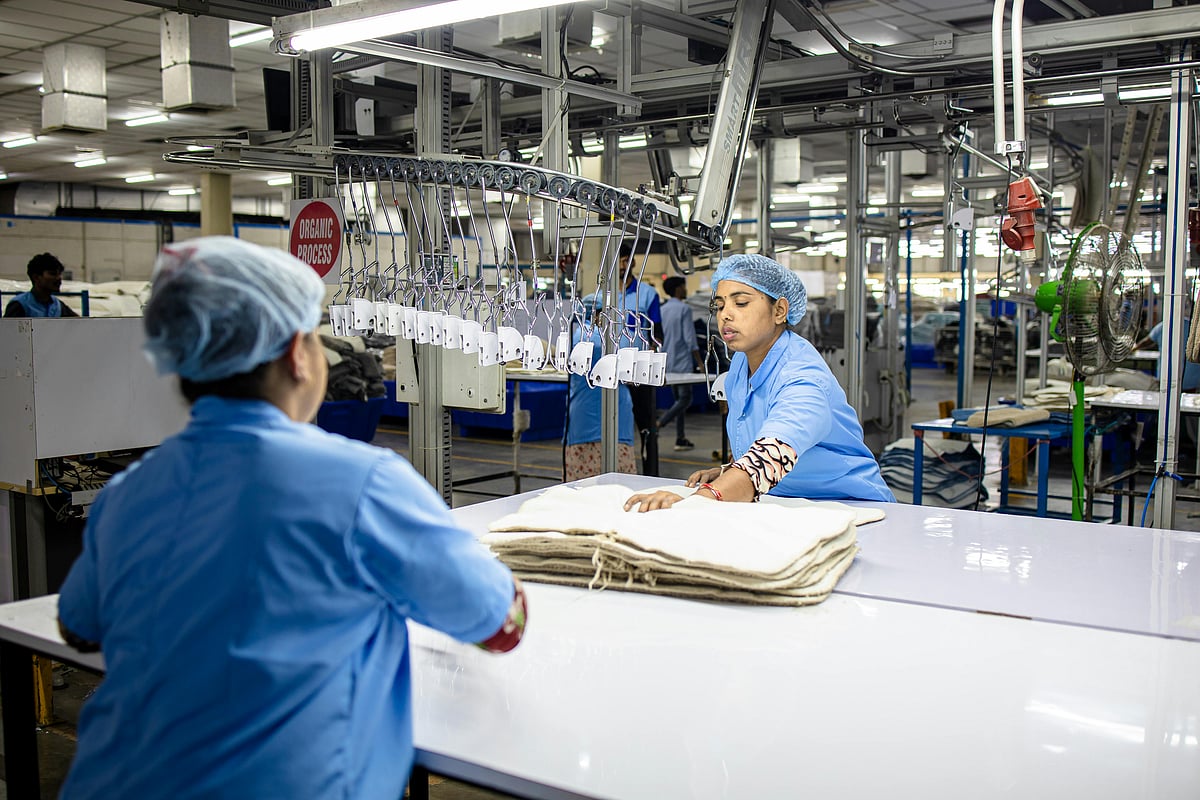
A bend between a few heaps of garbage leads to the colony of workers employed in the garment factories of Udyog Vihar in Gurgaon, an industrial city in National Capital Region (NCR), on the outskirts of Delhi. On a Sunday morning, in one of the many narrow alleys of the colony, several young men stand around a hand pump, waiting their turn to bathe and wash their laundry. At the entrance to a large compound lined with about 20 single rooms with asbestos roofs, stands Gyaneshwar, a 26-year-old migrant worker from Gorakhpur, Uttar Pradesh. Gyaneshwar is a new entrant to the garment industry, locally called the 'export line' of work, for its supply of garments to global retail brands. He is one of two lakh workers employed in one of the thousands of units located in Gurgaon. Most garment exporting units are concentrated in Udyog Vihar. For his work from 9 am to 5:30 pm, six days a week, he is paid INR 5800 (USD 92) per month. Given the rising costs of living, the salary is insufficient for workers like him, who work up to 15 hours daily, sometimes even on a Sunday.
Rashid, 55 and from Faizabad in Uttar Pradesh, has been in the industry for more than 20 years. Although a senior worker employed in a permanent capacity, his years of service have been punctuated by several breaks as he was forced to resign and join different organisations every time he tried to access his provident fund, which denied him the right to take out loans when in service.
As workers' regular salaries are inadequate to meet basic needs, overtime work has become necessary, a situation far removed from the life embodied in the luxury brands they create. Most will never own a single shirt of any of the brands they work for, despite having stitched thousands or even hundreds of thousands during their lifetime. Sher Ansari, a tailor at one of these factories, cannot even afford shirts cheaper than the brands he stitches for. "In the last twenty years, I have not bought a single shirt for myself. I always buy second hand stuff from the street vendors for 30-35 rupees [less than half a dollar]," he says. Ansari's comments are not surprising. The apparel manufacturing units in Gurgaon sell to international brands such as Gap, Marks & Spencer, Abercrombie & Fitch, Zara, Next, and domestic ones such as Biba, Satya Paul and Ritu Kumar. Clothes from these brands sell at several thousand rupees.
With growing demand from these companies for a steady and cheap supply of garments, India's garment industry is big business, and employs a massive work force. It ranks high in terms of contribution to employment in India (agriculture still employs the largest number of workers) and also contributes significantly to GDP and export earnings. In 2014, textile and garment exports to the US alone grew at 6.5 percent, compared to the 2 percent annual growth in the last five years. The spurt was fuelled by the revival of the American economy, and the decline in imports from India's competitors such as Bangladesh, after the Rana Plaza collapse and other accidents drew attention to safety concerns in that country.