
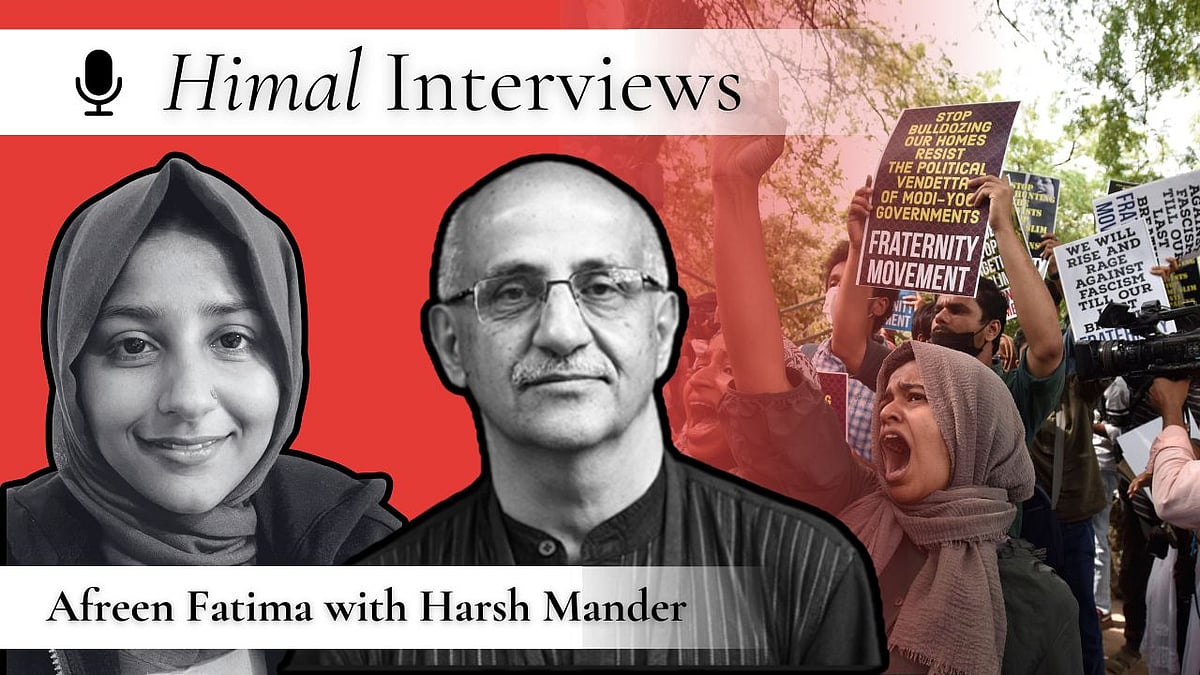
In June 2025, Himal Southasian launched a podcast series titled Partitions of the Heart in collaboration with Karwan-e-Mohabbat, hosted by the peace activist Harsh Mander. The inaugural season, called ‘Muslim Life – and Death – in Modi’s India’, focuses on the deepening crisis of Muslims in the country. Since 2017, Mander and Karwan-e-Mohabbat have done the extraordinary and difficult work of documenting a rising wave of hate and crimes against India’s Muslims, and of lending support and solidarity to victims of communal atrocities. In Mander’s words, “We live in deeply troubled times of visceral, everyday hate, violence, fear and division. The first step towards healing our growing fractures is to talk and listen to each other.”
This series is part of the effort to bring forward meaningful conversations on the increasing marginalisation and vilification of Muslims in India. In the season’s first episode, Mander spoke to Afreen Fatima, a researcher and activist whose own lived experience highlights some of the plight of Indian Muslims.
This interview was recorded on 5 May 2025. It has been edited for brevity and clarity.
You can listen to audio versions of this conversation on YouTube, Spotify and Apple Podcasts.
Harsh Mander
I know it’s difficult, but I think we need to probably start off with something that happened to you and your family in Allahabad now called Prayagraj – what you call extrajudicial punitive demolitions. I think that’s an excellent formulation of what we are seeing, this new phenomenon over the last five years or so. You know, it’s another thing to talk about it happening to someone else, but it happened to your own home. So what would you like to tell me and the viewers about it?
Afreen Fatima
Assalamu alaikum. I feel that in times when almost all the most basic aspects of Islamic faith is being criminalised, I feel it important to start with the salam because it is how we resist the erasure against Muslims. Coming to the demolition of my own home and this worrying trend of demolitions of Muslims’ homes and properties across India by, primarily by the BJP governments in different states, I feel there are aspects of extra-judicial and punitive demolitions that are not being accounted for; primarily that what's happening is not just punitive in nature, as in just punishing one individual for resisting or protesting or speaking up, it’s also a very collective form of violence.
HM
Against the community.
AF
Right. It’s collective in the sense that it also ensures that there is no collective formation within the community. So they make an example out of one person and everyone else should be scared of what happened to them and might also happen to us. This way of silencing is deeply troubling because it not just disempowers this one family, it also disempowers the community in ways that we have not yet been able to articulate. So, for example, I have had the opportunity to talk to families who have experienced similar demolition. So, when I talk about demolitions, it’s not just from a very personal or intimate place, but it’s also from this shared emotion of grief and this shared displacement, this shared dispossession that we’re all facing. So, I feel it’s very important to talk about demolitions primarily because, at one hand, we have the Supreme Court who gave out these guidelines to curb demolitions, but what’s actually happening on the ground is that the demolitions are still happening with absolute impunity.
HM
Most recently in Pahalgam as we speak.
AF
Right. So, when we address this issue, when we talk about demolitions, we have to understand what all failings are happening. So the first is that there is this impunity that law enforcement is exercising. A DM randomly decides that Javed Muhammad is part of a protest and he should be punished and demolishes his home without even checking if the home belongs – it does not matter even if the home belonged to Javed Muhammad - they can not just come and demolish a house.
HM
And Javed Muhammad is your father?
AF
Yes. And so that’s one part of it, the impunity that the law enforcement is doing and their impunity is linked to political backing and no one is talking about that also. Even in the Supreme Court guidelines, the Supreme Court says that the officials who are responsible for these demolitions will be penalised and they will pay for the demolitions and compensations. But what we’re missing here is that it’s not just this official who...
HM
…who actually performed the act.
AF
Right. He had some sort of political backing or he had some support from...
HM
Political backing/political instruction, both.
AF
Right; yes, political instruction, that’s a better word. So he’s not acting in isolation, there is this system that is enabling this kind of violence and no one wants to talk about this. This system needs to be put in check. The Supreme Court in its verdict acknowledges that there are extrajudicial demolitions happening. It did not once acknowledged to who is this violence happening to,which is also problematic because if you don’t identify the victim, if you don’t spell out that Muslims’ homes are being demolished, you do a disservice to the community that is facing this erasure.
HM
No, I agree with you fully. But when this happened in your own family, is this anything – and it’s deeply personal and if you don’t want to talk about it, that’s fine – if you want to talk about it, what would you like to share?
AF
So my home was demolished in June 2022. And in May 2022, in Kharwun and Sindhwara, a lot of demolitions happened post-Ram Navami celebrations. I had gone to MP, for a fact finding. And then in June, when my own home was demolished, I never thought that the bulldozers would reach my own home. You anticipate all sorts of violence against you. As a Muslim, we take a risk every single time we step out of our home. But in all those anticipations of violence or in all those moments where your head just keeps on telling you the kinds of violence that can or may happen to you and your family, I had not imagined the demolitions of my own home. Arrests, I had imagined; but never the absolute dispossession of everything we called our own. We had been living in that home for almost 20 years. I grew up in that house and it was, I mean, I think everyone has this sentiment towards this place where you belong.
HM
Home is much more than a structure. The memories it has….
AF
Yeah. So it’s a very hard emotion to sit with. I don’t think I have yet reconciled and I don’t think I ever would be able to, no one in my family, no one who has gone through demolition can ever reconcile with the massive loss that they’ve experienced. And we just have to continue and we are continuing, yeah.
I feel that we did not just lose this structure or this place where we used to live in. I lost so many books that were in that house, so many cards that my school friends had given me and written happy birthday Aafreen. All those things are not with me anymore and I am someone who cherishes these things. And it just feels sad when someone writes a nostalgic post on social media about their childhood or their teenager and I just don’t have the things that I was connected to anymore.
HM
With a lot of courage and resilience, I can see. I met your father and spoke to him. He, in some ways, was the worst brunt of this targeting because he was a leader of the community. There were protests against hate remarks against the Prophet by Nupur Sharma. And he was not part of those protests, but the police decided that he was the mastermind behind it. And in retribution, without any law that allows it, they broke down, broke down your home. But then they also arrested him. And he was in prison for how long?
AF
Around 21, 22 months.
HM
22 months. That is that is mounting you know a whole different level to this. So, ultimately today he is out, but how did the family deal with this injustice?
AF
I think the worst part of it all was that initially he was detained and then our house was demolished. So when our home was actually being demolished, we were more concerned about Abu because we did not know where he was taken by the police, what they were doing, what they were planning, nothing. And so our immediate response was to sort of find out where Abu is – and he is a heart patient, he has blood pressure problems, he’s diabetic. So all of that concerns coupled with this overwhelming emotion of seeing our own house getting demolished. All of this combined – I feel that we all just felt lost for a very long time. We were just trying to take on this legal battle against a state that was hell-bent to keep him imprisoned. Even if he would make bail, they would charge another case against him, which was the most brutal kind of violence because we’d have this hope of seeing him again, of him coming out of the prison. And then a new case would be lodged against him, and then again and then again and then again. So, earlier in my speeches, I would say that the process is the punishment. And having gone through the punishment, I now know how difficult and why is the system designed this way. It breaks you in ways you never imagined. So, Abu was lodged in Devaria district jail, which is around 300-350 kilometers away from Allahabad.
HM
That is a further punishment, I mean – to deliberately put him so far away where the family cannot be in regular touch.
AF
Yes, so, Ammi, me, my younger sister, all of us would go and visit him. Initially, he had two mulakats per week and then for some reason, they just made it two per month. So, we would go meet him twice every month, and – the process of meeting also is in itself also a punishment because you are part of this line. The jail authorities know who you are coming to meet, who your family member inside is, what are the cases against him and they act accordingly. Even if our name would be on top, they call us in the end to meet. So, the person who enters the jail first gets around 30 minutes. The person who enters the jail last gets around 15 minutes. So, this kind of stuff would happen.
HM
And, now that he’s out, are the cases closed or do they continue?
AF
The cases are still ongoing. I mean, we all know how long the judicial processes are. He has to go to the lower court for his hearings often. He’s still troubled by the police.
HM
So, going back to a couple of things that you said, one thing that you said is every time you step out of or someone from your family steps out from the home, there's a sense of fear. And this is something, actually, I’ve heard from people of Muslim identity across the country in many, many, many conversations. Where do you think this comes from? Why do you feel this fear? Can you give it a name, a sort of a reason or is it the broad sense of feeling insecure?
AF
More than fear, I feel that it’s a risk that the Muslims take because we still come out of our homes, we still go on with our day-to-day lives, we still – despite the lynchings, despite the different ways of brutal assaults that Muslims are being made to go through, be it the economic boycotts, be it processions outside our mosques – everything out there. It’s not that things were very great before 2014, but it says that things are so violent and so the violence is so pronounced that it’s just become difficult to even breathe as a Muslim, let alone do anything, right?
And, all of this is because there is this prevalent propaganda machinery which is day in and day out spewing venom against the Muslim community. Day in and day out – finding ways to dehumanise Muslims, finding ways to criminalise Muslims, finding ways to render us as second-class citizens and making sure that we do not have any way to redress or to access the basic rights or privileges of our own citizenship because that is what is happening. As Muslims, we cannot even access the basic rights of our citizenship and in that line, what…
HM
And the bulldozer is a good example of that – because there’s no law, there’s not even a pretense of any rule of law in the process.
AF
All sorts of like, you know, even the arrests of Muslims. It’s a big threat to our civil liberty and there is… for some reason it feels as if like, you know people have taken it as a given, that okay, Muslims would be arrested; and there is not enough challenge to this ideology that is all-encompassing and it has seeped to this level where it is not just a propaganda machine, it has become actually a cultural phenomena. There is an increasing population within the Hindu community who has made Hinduism to be this obsession against Muslims. That all their religious and cultural duties are to oppress Muslims, vilify Muslims, humiliate Muslims and hate Muslims; and this is an increasing trend because you see it happen in every single festival. What happens is that there’s… You’re celebrating your festival outside the mosque – and that’s one thing. So, this increasing hate against Muslims, it’s deeply problematic and the level of this hate has stooped to the lowest of low. So, for example, there was a religious leader. He called for rape of Muslim women and he called for, he publicly called for rape of Muslim women, which in itself is a very...
HM
Big crime yet.
AF
It is a hate speech – that’s one thing, but it’s also a very morally corrupt thing to say. It’s something that reeks of a moral decline and what's more worrying is that his remarks are received by a crowd which comprises of men, women, children and they cheer when he says this as if he has articulated something that they had longed to hear and that is more worrying to me because I feel that what’s happening now is that this is the society that we are living in. This is a society where calling for rape of a woman is so normal that no one really bats an eye and what’s worse is that it’s not just towards, directed towards Muslim and I don’t see an acknowledgement of this within the Hindu community and it really, it’s very concerning to me. So the kind of moral, ethical decline that we’re seeing is deeply concerning and I feel that there is no acknowledgement, but I do believe that the good people in the Hindu community are concerned about this and it is very important that we, sort of, at least start acknowledging this hate and this level of perversion.
HM
So, just in terms of your lived experience, to live with your head high as an equal citizen – as a believing, practicing Muslim – what difficulties do you find?
AF
So I’ll start with when I was a student of Aligarh Muslim University. I was the elected president of a women’s scholar students union. And incidentally or coincidentally, I was not a hijab-wearing Muslim woman. And for some reason, I was very accepted. And when I moved on to JNU and I chose to wear a hijab as a religious obligation, I was all of a sudden not as much accepted as I was earlier and the reason why I want to talk about this right now is because that there is a certain – even among the most well-meaning circles – even, even among the most liberal progressive spaces, there is a certain kind of Muslim who is accepted and that needs to change. We need to sit down together and have honest conversations and - we don’t have to agree with each other. So, there is a certain kind of Muslim who is accepted – who talks a certain way, who dresses a certain way, who conforms to a certain ideology. So, I personally feel even in these spaces, where I – sometimes invited, sometimes not invited, sometimes invited but...
HM
…[with] some reservations.
AF
Yeah. So what actually happens is that though it seems everything is well. ‘Oh see there are Muslims in this organisation’. So for example in JNU, the joint secretary is always a Muslim candidate, always a Muslim candidate from the left unity. And, but at the same time, the same left unity would not want someone like Afreen Fatima speaking up because I would be challenging their own Islamophobia, their own reservations against a certain kind of Muslims. So, there is this boxed mould that has been made and as long as you conform to certain ideologies, and when I talk a certain way or walk a certain way, it means that I must be using this language which comes from this burden of proving my nationalism. It should be always framed from a secular point of view. It should always be very docile. It should not be furious. It should not be angry. It should not be disturbed by what is happening. It should always be inviting. It should always be all accommodating. It should always be conforming. So as if, like, making them feel good about themselves for having me around, and it’s very problematic to me because until and unless we all decide that you’re going to be here and I'm going to be here and we’re all going to be here and no one is going anywhere and…
HM
And no one needs to go anywhere because this country belongs equally to you.
AF
Absolutely! And that we all will have differences, we all will believe in different things, we all will have convictions coming from different places and we all will speak differently, look differently, be differently and we all will still be here. And both of us do not have to agree on every single thing for us to come together and have a conversation. And, what my experience in these liberal spaces has been [is] that I need to conform to certain things that I don’t personally believe in to be able to be a part of these spaces, and it’s...
HM
For example, for example?
AF
For example, I was part of the JNUSU. I was elected from fraternity movement and Bapsa Alliance. And I was the only Muslim woman in my council who was not from the left unity. And even to get a resolution passed, I would have to change my resolution. I would have to change the framing of it. I would have to retract certain parts of the demand. For example, we asked for a Muslim reservation – deprivation points in JNU admissions. We have deprivation points. We demanded for a Muslim deprivation points. And, we would have to change stuff actually from what we are demanding.
HM
JNU did not have Muslim deprivation points before?
AF
No, it does not have. We did not ask for Muslim, we asked for minority deprivation points. It would apply to Christian and Sikhs as well. But, so like you know - we have to actually retract stuff we actually want to do. We have to, like, quiet down our voice a bit, tone down. There are only a certain amount of – there are certain slogans that we can say and certain slogans we cannot say. So for example, during the CAA movement, everyone criminalised the slogans of La Ilaha Illallah, which was deeply problematic to me because the CAA was not just this...the celebration of the idea of India. It was also coming from a place where Muslims finally said “enough” and that is why all of us were out in the streets. And it was so disturbing to me that just me saying “La Ilaha Illallah” would make someone feel uncomfortable, and [they] would ask, and they would actually say, that this is a very communal protest. La Ilaha Illallah is not communal, it’s the most basic tenet of Islamic faith and if you find that communal, then I’m not sure how much can we engage with each other because it is actually the most basic tenet of Islamic faith. That is the first thing a Muslim says when they accept Islam. It’s instances like these that make you feel unwanted, that make you feel that your identity is a burden on you. You are made to feel that your identity is a burden on you.
HM
Yeah, I hear you loud and clear, Afreen. And I think – I encounter this kind of resistance to religiosity more generally, but this is resistance to religiosity of Muslims in particular, as something that often goes against the grain of people who regard themselves to be progressive and left. I think there’s, first, a fundamental misunderstanding of what Indian secularism is about. Because Indian secularism was never a denial of faith, but equal respect for every faith, including the absence of faith. And, so I think this discomfort with expressions of religious belief is something that the left and liberal world has to come to terms with. And that itself is a kind of intolerance. I mean you’re opposing intolerance, but in a sense, you’re also expressing a form of intolerance. Right, I hear that.
The question of the hijab becomes even more complicated because, I won’t mention names, but have close friends who have in fact critiqued me for not critiquing the hijab, and – both men and women, including women of Muslim identity, who somehow believe that the hijab is almost by definition something that oppresses women and therefore, there is a kind of discomfort. I find it strange because it is an identity marker just as much as the Sikh turban is an identity marker, but nobody seems to have a problem with that. The skull cap is an identity marker. People often have problems with it, but they don’t express it in the same way. The hijab is somehow considered as oppressive of women’s equal identities. So, how would you respond to a critique of that kind?
AF
When people are actually critiquing the hijab as oppressive, we have to sort of come to terms with ‘what does oppression actually mean to us?’, right? That’s one thing. The other thing is that I would not say that – that there are Muslim women who might have had a bad relation with hijab. I would not deny that. There are. I also, at some point of time, struggled with wearing a hijab. It’s a religious obligation and it’s a journey. And we’re all at different paths, and it’s a very intimate journey that a Muslim woman has. And it’s true to all other aspects of Islamic faith also.
I struggle with Namaz sometimes. A Muslim man might struggle with keeping a beard sometimes. But nothing is perceived as oppressive. My struggle in Namaz, me not praying five times – or me praying five times, would not be considered oppressive, right? Then why is Afreen wearing a hijab as a symbol of her faith, as a religious obligation towards her belief and faith is oppressive. That’s one thing. The other thing is that it also comes down to this very male gaze… this consolidation of women’s clothing to cater to a certain gaze, which is very disturbing. Why is it that every single time a Muslim woman who chooses not to wear a hijab – she is celebrated – but a Muslim woman who does choose to follow her obligations is not celebrated, is not accepted.
The day I started wearing hijab, it was a personal win for me, it was a celebration for me, then it’s my journey and I don’t want to impose my journey on anyone else. But at the same time, just by merely looking at me, if you’re going to decide that I’m oppressed and my father must have forced me to wear this hijab, it’s very reducing, it’s very infantilizing and that is what oppression is, because you are oppressing me, because you have this limited worldview where only women looking a certain way are free, independent. And women looking a certain way are docile and meek and submissive and are oppressed by the male members of their community. That is deeply problematic. I think the only people who can decide if hijab is oppressive or not for them is Muslim women and it’s a very personal intimate subjective journey. We cannot generalize hijab.
HM
I also see that in this sort of judgmental call about hijab, there's also an implied kind of double standards all the time because in many Hindu communities women cover their heads and even have a pardah over their faces. But I found it particularly interesting in France where not just the hijab but covering your body completely when you go to swim became an issue, where it was even considered almost like an act of terror and it was called an act of terror. And I saw this picture of Catholic nuns in their habit which also quite closely resembles a hijab. Going fully clothed to the sea and having fun together. Somehow there’s a particular judgment to... I mean the choice of women to cover her body is her choice. But it gets people’s backs up when it is Muslim women who choose to cover their bodies. My wife would not... would feel very embarrassed to... go into the sea uncovered. But nobody would sort of look twice as to why she has that hesitation. So I think that’s a problem, and… but I mean, how would you look at a Muslim woman who chooses not to wear a hijab?
AF (34:14)
I would look at her as a Muslim woman.
HM (34:15)
Oh, yes, absolutely.
AF
See, that’s the problem where this whole debate is very disturbing and problematic is where, like you know, a Muslim woman is a Muslim woman, there is no hijabi Muslim woman and non-hijabi Muslim woman. That’s one thing we have to understand that a Muslim woman is a Muslim woman. What is this weird obsession that people have that she’s a hijabi Muslim woman, she’s a non-hijabi Muslim woman, she's a practicing Muslim woman, she’s a non-practicing Muslim woman. The tenets of Islamic faith are as such that every single aspect of our faith is something that we have a very deep, spiritual, intimate relationship with and it’s not just hijab. There are Muslims who don’t offer namaz five times a day and there are Muslims who offer namaz five times a day and there is no differentiation between them. So why is there a differentiation between a hijab-wearing Muslim woman and a non hijab-wearing Muslim woman?
HM
But you also said anger, rage and outrage.
AF
Yeah.
HM
People feel uncomfortable with it in left and liberal circles. That I found more interesting. The first I encounter myself, in the fact that, ‘why do I not call out some of these things?’ And I say ‘there is no reason to call out because people have the freedom to follow their beliefs and practices’. And it’s only the misuse of religion for hate that we oppose and we should not be opposing religion at all. [With that] I am clear, but this feeling that you had in your experience in a place like JNU that there was an expectation of a certain kind of docility – the absence of overt rage, that’s a very important critique that you’ve raised. So would you like to explain that a little more?
AF
So, like I said earlier also, there is only a certain kind of Muslim who is accepted, right? A Muslim who is articulate, a Muslim who is able to use language to articulate the violence that they are expressing, to pinpoint what is happening, why is it happening, how is it happening and is not dependent on a language that is secular in nature, a language that I have to borrow from these left liberal spaces, is somehow, it challenges the status quo. It challenges the people who had – have – claimed to be the saviours of Muslims for so long. They want to have the mic to themselves. They don’t want to give space to someone like Sharjeel Imam who I believe, in today’s time, is one of the most important public intellectuals. He spearheaded the anti-CAA movement and he was one of the first persons to be arrested for protesting and the kind of betrayal that he faced was jarring.
It’s so sad that people feel threatened by his presence. When he was arrested, JNUSU, he was a student – he is a student – of Jawaharlal Nehru University and Jawaharlal Nehru University Students Union disassociated with its own student. No one was willing to speak about him, no one was willing to accept him simply because he was this unapologetic, articulate Muslim man. That was the only reason he was shunned, and [only] after some time when it became absolutely impossible for them to ignore him, was he supported with a conditional solidarity. And, I feel that for all of us to come together and actually fight for an idea of India where we are all equal, where there is equity, where there is no oppression, where religion is not weaponised against each other. It is only possible if we are willing to accept voices from within both of our communities that might not sit – so for example, I might be uncomfortable with what Sharjeel Imam is saying but at the same time I should be able to…
HM
Allow him the space and to listen.
AF
Yeah, listening is what is most important because I feel that oftentimes – like Spivak says, talks about, ‘can the subaltern speak? Who is a subaltern?’ A subaltern is someone who can speak, but they’re not listened to. And that is what's happening with Muslims right now. We are not listened to. We, even in the Shaheen Bagh movement, even in the anti-CAA movement, we had our own stage, we were speaking, we were doing everything – but who was listening to us, is the question. And to be very honest, I don’t feel anyone listened because, had we listened, had the Indian society listened to what Muslims were actually saying, things might have been a bit different. We would have felt less insecure. We would be able to step out of our home without feeling that fear that we earlier talked about.
HM
So Afreen, you felt that there was something in the CAA movement. I do feel that that was a time when Hindus and Muslims came together and were listening to each other. So in what way did you feel that Muslims were not being listened to even during the CAA movement?
AF
I agree that it was definitely a time where Hindus and Muslims and people of all faith came together. I do not deny that. But at the same time, we cannot ignore the fact that the major chunk of the protesters were from the Muslim community. And it was simply because the threat was too personal to them. And, what people actually failed to realise with the movement, with the protests, with the language of the movement was that we were not just protesting the CAA. We were not just fighting for our constitutional right to equal citizenship. We were also fighting the erasure that we were forced into. We were also fighting the violence. We were also fighting the different ways in which we have been pushed to the margins.
And, the CAA protests for us was a breathing space where we could just be and with our identity on the street and resist and articulate this resistance in our own terms, in our own language. And… the reason why I say that we were not listened to is because people generally reduce the entire movement to Muslim women protesting, which is there is no denial of Muslim women's presence in the CAA movement, in the different Shaheenbaghs across India. No one can deny this and it was historic and one cannot deny that as well. But it was not just that.
2019 was a year where there were attacks after attacks. I mean, the Babri verdict was pronounced, 370 was abrogated, so many things were happening and then the passing of the CAB and then CAA, it just felt like we had reached our saturation point and we had to come out on this.
HM
There was also the series of lynchings…
AF
Definitely. So everyday violence that cumulated towards this massive resistance movement and the Muslims were resisting for space to be.
HM
Yeah, I might contest you a little bit. I think it was a time when so many people from other communities came out because they understood the larger context of what is happening to India’s Muslims and not just the Citizenship Law. The Citizenship Law – I mean, the build-up of the hate campaigns, the lynching, Kashmir and the Babri Masjid and all of that coming together – I feel that that is what, I mean, roused people to come together with their Muslim brothers and sisters. But I also agree that it didn’t go deep enough because why doesn’t it continue? Why don’t those solidarities, why is that empathy, why is it again sort of receded to the background? But why it didn’t sustain is something that all of us need to introspect on. Since we have the time, you spoke about Sharjeel Imam’s ideological contribution as being very specific and important. How do you see that? How would you like to articulate that?
AF
The reason why I call him one of the most prominent public intellectuals of our time [is] because if you go and read his works, his writings, his MPhil thesis, he is not just talking about Muslims, he’s talking about – he’s articulating – ways in which Muslims have not been talked about. So he had been one of the most sanest voices during the anti-CAA movement and he had not said a single thing that can be taken as anti-national or that would amount to a UAPA against him. And in all of that, I feel that this is the very reason why he was incarcerated. And that he was the first incarceration simply because the state realised the power of his voice.
It was his speeches that were being circulated within the Muslim community that were inspiring Muslims from Kerala to Bihar to Northeast – everywhere, to come out on the streets and protest and that’s what threatened the state the most. Because an articulate Muslim who knows what his rights are, who knows what his privileges as a member of this nation are, and who is able to identify not just the fault lines of the citizenship amendment bill but also the fault lines in the solidarities that we were receiving. In the way other people were articulating our violence, in the way our identity was being erased – and not just by the right wing but also by secular liberal frameworks – and that is why he was silenced. And it’s so sad that people who claim public intellectualism, people who are accepted, celebrated public intellectuals, they did not have the time to listen to a 40-minute speech and believed in Amit Shah’s 15-second version of his speech.
HM
So, Afreen, going beyond the protests and coming into everyday life today; I was born many years, eight years after freedom. But I still, we all remember a much more idealistic time in this nation, which sadly those of you who are much younger have never seen. You’ve seen in India after the Babri Masjid movement. You’ve seen in India after neoliberalism has taken over.
For those of us who come from an earlier generation, the belief in the idea of India, which we call the idea of India, is easier because we’ve seen it imperfectly, but we've seen it play out in the way that we live our lives and in terms of our relationships. You have come of age in a much more difficult time. So speaking for yourself and other young Muslims of your age, how hopeful are you?
How much does this idea of India enthuse you? How much does the constitutional promises enthuse you? How much does Gandhi and Maulana Azad and Ambedkar and Nehru inspire you? Or are you losing faith in all of this? Is there a different vision for our country that you see?
AF
All young Muslims of my age, we do believe that there is a possibility of all of us to coexist, of all of us to have equal rights, equal citizenship, dignified existence, that there would be no religious violence, there would be no caste violence, that Adivasi lands would not be grabbed and all of that we believe in that and that is why we come out on the streets and protest every single time.
But at the same time, you know, we – I – feel that this young generation, we are not just witnessing first-hand violence. We are actually experiencing first-hand violence and at the same time, we are a generation that is much more educationally uplifted to say so? That we are reading history, we are going back to history and we are seeing that – how is it that this India that was so ideal still had its issues with Muslims. Muslims were still the other. Muslims were still criminalised. Muslims were called terrorists and put to jail for 20 to 30 years of their life only to be acquitted later. How is all this happening and the elder generation of Muslims did not care about it? What was happening?
And it just does not make sense to me that my father would just be reminiscent of his times and not be able to see the violence, the everyday violence that was still there present and I feel it has to do with the way the media at that time portrayed the Ganga-Jamuni tehzeeb kind of stuff, and coexistence and peace and everything. It was like as if a carefully crafted stage and behind the curtains is where the violence was happening, and no one was able to view it.
I personally think that the youth today in the Muslim community is not just angry at the state. We are not just angry at RSS and BJP for all the violence through media narratives, through pop culture, through films, through every single institution of this, of the Indian state.
But also we are angry at this generation who romanticised the Ganga-Jamuni Tehzeeb to an extent that it [is] as if there was no violence happening.
It just feels that the violence that was done to Muslims has been completely erased as if no one remembers that there was a time when Muslims were being arrested as terrorists, was a time when Muslims were being burned in broad daylight in pogroms and riots. And there’s only so many people who are able to acknowledge. But the vast majority is just, ‘okay, before 2014 everything [was] very good’ – which is not true. Things were very disturbing for Muslims. The moment this nation state came into existence, Muslims were all of a sudden made this ‘other’. And, to this day, we have been made to bear this burden of proving our nationalism, proving our secularism, which is a given. In, especially like you said, the India secularism is respect – mutual respect – for all faiths and it’s just missing… there is no respect for Muslims, definitely not towards our faith, and it’s just infuriating to us that no one wants to acknowledge that things were bad before 2014 as well.
HM
Yeah, I hear your rage and I understand where it is coming from. I feel that the sort of everyday hate and violence that Muslims are increasingly being subjected to… what you’re trying to say is that this hasn’t suddenly come out of nowhere and it’s not simply because we have a BJP government today. But there has been a steady decline and various kinds of betrayals of the idea of India itself over many decades after independence. Is that what you are saying?
AF
Yes, that’s exactly what I’m trying to say that there – to be actually able to challenge the BJP and the RSS and the Hindutva genocidal project, we have to come to terms that they were not just born overnight in 2014, that – it’s so bizarre that people would simply not acknowledge the groundwork that the RSS has put into come to power…
HM
For 100 years.
AF
For 100 years. And if our only response is going to just wait for a change in government, for our saviours to come back to power, I am afraid that the hate that we are experiencing, the Muslim community is experiencing, is not limited to a political party anymore. The RSS and the BJP have infested the minds of the Hindu population. And this hate is not going to evaporate overnight with the change in government. And the opposition is absolutely dead. They are not willing to put in the effort to be able to challenge this hate. And, I don't know how a political party as big as the Congress can claim to be merchants of love while not actually acknowledging the hate, the Islamophobia, the anti-Muslimness that is perpetuated deep within the society.
HM
So, I mean, just for the record, I agree with every word that you’ve said in the last few minutes. I think the Congress has shown very little moral and political courage to fight the battle. They’re not speaking out. I keep saying this to them and I agree with you. And that simply a change of government will give us a little more breathing space, but it’s not going to solve the problem because the problem is not simply from the state, but in how much the poison has spread in the hearts and minds of more and more Hindu hearts and minds. So, I agree with that formulation completely. But Afreen, there is no obligation to hope. But do you feel hopeful and if so, what are the sources of hope? When you reach my age, what kind of India do you think you'll be living in and are you hopeful about it?
AF
Most definitely! I feel that over the course of time, I’m not sure if I will see a better India, maybe the next – my children – might. But at the same time, I refuse to give up on hope, and simply because of two things: [one is] that I have been raised in a way that my duty is to keep resisting. It is imperative that I keep resisting in whatever way it is possible for me. If I can come out on the streets, I would. If I can’t, I’d find another way to do something that would just say that ‘I’m not going to sit with this happening. I am not okay with what’s happening’.
And that is one. Another is that I feel that hopefulness is a religious duty to me as well because in Islam there is this… the saying that “naumidi kufr hai”, kufr is not believing.
HM
Yes, blasphemy.
AF
And, yeah, I think for most, this is the only reason why the Muslim community is able to brave the kind of violence that we have been subjected to. It’s not simply because we have clung on to hope. It’s because it is our religious duty to cling on to hope and to believe [that] justice will come. If you are hopeful and you are not doing anything about it, then you are not hopeful really.
HM
But is there anything that you’d like to say that gives you hope when you look around?
AF
I see Muslims [and] people from oppressed, marginalized communities resist in different ways every day. I see people in jail. My friends are in jail for over five years. My father was in jail. My husband was in jail. All these people who have been tried by the state in so many different ways and their resilience, their courage, their unwillingness to give up is what gives me hope. Sharjeel Bhai, Umar Bhai, Miran, Gulfisha, all these people, they’re...to this day when they come to their hearing, they're smiling and that smile is what gives me courage to hold on to a better world.
HM
Thank you, Inshallah, that better world you will see in your lifetime, I may not, but we must believe in it and we must struggle for it.
AF
Inshallah.