
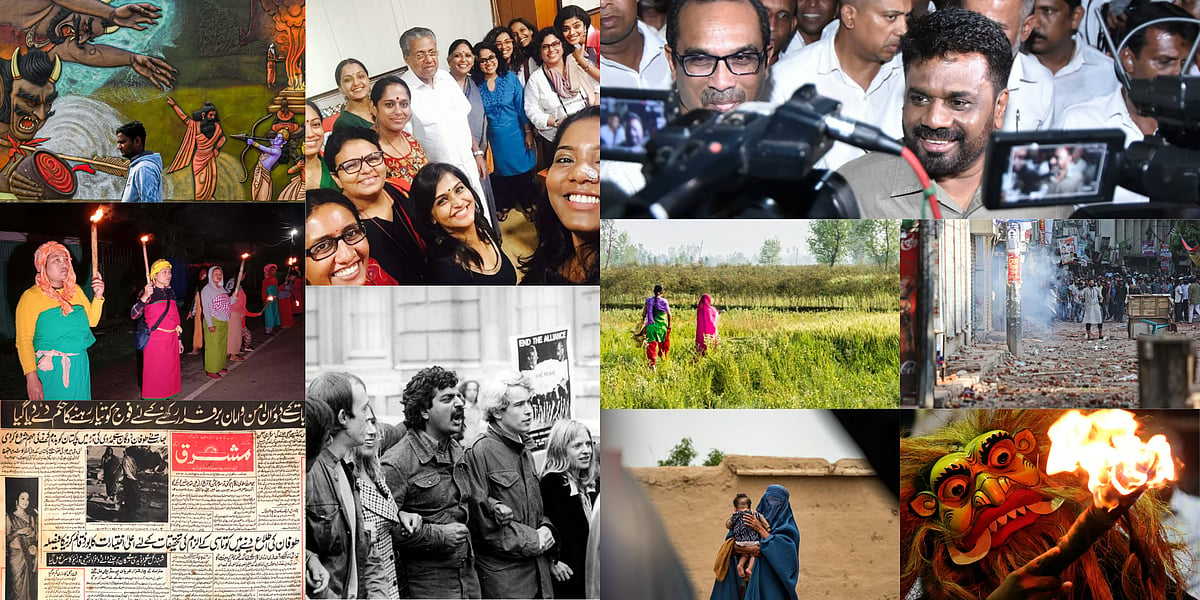
In 2024, Himal Southasian launched two new podcasts: State of Southasia, where Southasia’s top minds unpack essential news and events, and the Southasia Review of Books, the place for conversations on all things literary in the region. We’ve also doubled our output of podcasts, from publishing an episode every two weeks, we’re now releasing a new episode every single week.
In no particular order, here are a few of Himal’s most-listened-to episodes of the year:
State of Southasia #14: Patricia Mukhim on Manipur’s unending crisis
Manipur has been mired in an ethnic and political conflict since May 2023, primarily involving violent clashes between the Meitei community, which predominantly resides in the Imphal Valley, and the Kuki-Zomi-Hmars, which are tribal communities mostly living in the state's hilly areas. The violence, fueled by longstanding ethnic tensions, has resulted in hundreds of deaths, widespread displacement and the destruction of property. The state’s governance has collapsed and citizens have armed themselves against each other because of the failure of law and order.
Patricia Mukhim, a senior journalist from Shillong, highlights the state’s failure to address long-standing inequalities and warns of the current dangerous stalemate, with both communities disillusioned and no resolution in sight.
Listen on Spotify, Apple Podcasts and Youtube
Southasia Review of Books podcast #02: Smriti Ravindra on exploring the Madhesi identity in the literary imagination of Nepal
The Woman Who Climbed Trees by the Nepali-Indian writer Smriti Ravindra is a searing story of three generations of women and the challenges faced by them in traditional societies across India and Nepal.
The novel, set partly in the late 1980s and early 1990s of Kathmandu, also traces the major political transitions of Nepal, addressing questions of ethnicity and corruption, and in doing so, the book sheds light on the long-ignored topic of the Madhesi experience, particularly that of women, in Nepali literature – which we explore further in this conversation.
Listen on Spotify, Apple Podcasts and Youtube
State of Southasia #10: Ambika Satkunanathan on Anura Kumara Dissanayake’s win and the landmark political shift in Sri Lanka
In 2019, Anura Kumara Dissanayake contested Sri Lanka’s presidential election against the incumbent Gotabaya Rajapaksa. He won only three percent of the vote. In the parliamentary elections a year later, the National People’s power – the coalition that includes Dissanayake’s party, the Janata Vimukti Peramuna – won only three seats. The JVP was disparaged as the “three percent party.” In 2024, Dissanayake turned the tables by winning 42 percent of the vote share. Meanwhile, Namal Rajapaksa, the son of former president and prime minister Mahinda Rajapaksa, secured only 2.57 percent.
Ambika Satkunanathan, a lawyer and former commissioner of human rights in Sri Lanka, explains how sections of the populace, including the Tamil minority, are wary of Dissanayake, given the JVP’s history of violent insurrections in the 1980s and its leftist economic outlook. However, she says, he has made the right moves in reaching out to business communities and showing an eagerness to work with everyone.
Listen on Spotify, Apple podcasts and Youtube
Southasia Review of Books podcast #05: Siddhartha Deb on India’s macabre new realities
The Light at the End of the World, Siddhartha Deb’s first novel in fifteen years, reinvents Southasian fiction for our time. The novel, beginning and ending in a dystopian future of authoritarianism and climate disaster, blurs the lines between realism and speculative fiction. It captures the puzzle of contradictions that is modern India today, and traces it back to the many moments of apocalypse in the Subcontinent’s history.
Over the past decade and a half, India has pivoted from a seeming success story, revealing itself to be a stranger-than-fiction dystopia. In his recently published collection of essays, Twilight Prisoners, Deb paints a damning picture of these darkest of turns in India’s recent past. It is a powerful exploration of the rise of Hindu Nationalism and its impact on dissenting voices and marginalised communities.
In this conversation, Siddhartha Deb talks about recording the histories of India’s present and the dystopian futures of climate crisis and authoritarianism in his fiction and nonfiction.
Listen on Spotify, Apple Podcasts and Youtube
State of Southasia #07: Ali Riaz on how Bangladesh’s mass protests have already transformed the country
The Bangladesh government has been at war with its people. The protests in July against quotas in public-service jobs, which began on university campuses and spread after violent repression by the government and ruling party, have come to symbolise Bangladesh’s deep discontent with the rule of Sheikh Hasina and the country’s slide towards single-party autocracy.
The country has settled into an uneasy peace but the reasons for the mass uprising are far from being resolved. In this episode, Nayantara Narayanan speaks to Ali Riaz, distinguished professor at Illinois State University, who studies democratisation, violent extremism, political Islam, and Southasian and Bangladeshi politics. Riaz details how, after the government displayed absolute disregard for people’s lives, it has further lost legitimacy and seen the political ground shift in Bangladesh.
Listen on Spotify, Apple podcasts and Youtube
Southasia Review of Books podcast #11: Sex, scandal and the death of a poet in 1970s Karachi
On one October morning in 1970, phones began ringing all over Karachi. The established poet and former civil servant Mustafa Zaidi had been found dead in his bedroom. He wasn’t alone: Shahnaz Gul, a socialite in her late twenties, who was Zaidi’s muse and lover, was lying unconscious in the next room. What seemed like an apparent suicide turned into a scandal, ensnaring Shahnaz, and threatening to expose Karachi high society.
Over fifty years later, the journalists Saba Imtiaz and Tooba Masood-Khan explore this question in their podcast, Notes on a Scandal, and in their new book, Society Girl. Their retelling of, and years-long investigation into this story led to a far more complex tale. It is ultimately not just about Mustafa and Shahnaz; but about the forces that existed during that time - the press, the elitist social structures, and the power dynamics in Pakistan – all just as potent today.
Listen on Spotify, Apple Podcasts and Youtube
State of Southasia #09: Anna M M Vetticad on the gender reckoning in Malayalam cinema – and India’s film industries
In August this year, the government of the Indian state of Kerala released 233 pages of a report on gender discrimination in the Malayalam language film industry based in the state. The government released the report six years after it was commissioned and more than four years after it was first submitted. The report has come to be called the Hema Committee report, named for the chairperson, the former judge K Hema.
Since the report was released, a number of women have made allegations of sexual misconduct against men in the industry, triggering another #Metoo wave. The government has constituted a special investigation team to look into the allegations.
The film journalist Anna M M Vetticad points out that the sexual abuse, while horrific, is only a symptom of larger systemic problems in an industry that needs structural change from the ground up. In this episode, she speaks about the findings and flaws of the report, institutionalised misogyny in Malayalam cinema on-screen and on set, and why this is a moment of reckoning for all of India’s film industries.
Listen on Spotify, Apple podcasts and Youtube
Southasia Review of Books podcast #06: Vajra Chandrasekera on writing fantasy and science fiction from Sri Lanka
In his debut novel The Saint of Bright Doors, the Colombo-based author Vajra Chandrasekera paints a vivid picture of a city on the brink – tracing Fetter’s path from child assassin, raised to kill his saintly father to misguided adult with the ability to see devils, anti-gods and magical traces of their world – like the mysterious bright doors. In blending the mundane and fantastical with violence of colonialism, religious control, and the struggles against these systems – the book captures the complex of the power structures that shape us.
His second and most recent novel, Rakesfall, is a complex portrait of death and reincarnations. This cross-genre science fiction epic, following two souls as they reincarnate and echo across alternative realities, the mythic past to modern Sri Lanka, its long drawn civil war, to a far-future Earth abandoned by humanity.
In this wide-ranging conversation, Chandrasekera talks about the two novels, fascism, tescrealism and the current moment of Southasian speculative fiction, and more.
Listen on Spotify, Apple Podcasts and Youtube
State of Southasia #08: Kate Clark on how Afghans are coping after three years of Taliban rule
On 21 August, Afghanistan’s Taliban rulers formally issued “vice and virtue” laws codifying rules of lifestyle and behaviour, entrenching their control over social interactions and the private lives of people in the country. The laws say that Muslim women must cover their faces and bodies around non-Muslim women and all men who are not “mahrams” – their husbands, brothers, fathers, sons, grandfathers or uncles. They also deem a woman’s voice to be intimate and say that it should not be heard singing, reciting or reading aloud in public.
The diktat came a week after the Taliban celebrated three years of establishing the Islamic Emirate of Afghanistan in August 2021, after the withdrawal of US troops from the country and the fall of a republican government.
The two most immediate and momentous fallouts of the change in Afghanistan’s leadership in 2021 were the drying up of foreign-exchange reserves, leading to the collapse of the economy, and the crackdown on the freedoms of women. Kate Clark, the co-director of the Afghanistan Analysts Network, a research organisation in Kabul, talks about how the Afghan people have been coping with deprivation under the repressive regime.
Listen on Spotify, Apple podcasts and Youtube
Southasia Review of Books podcast #13: Tariq Ali on a life in writing and dissent
A sharp-eyed eyewitness to a chaotic and confusing world, the renowned Pakistani-British activist, writer and public intellectual Tariq Ali understands that its problems don’t ever change, they just take different forms.
In this conversation on his new memoir, You Can’t Please All: Memoirs 1980-2024, Ali recounts a life committed to socialist and anti-imperialist activism, to writing and cultural intervention that ushered in a new era of dissent. He discusses neoliberalism in the West and turmoil in Southasia, and fiercely critiques the War on Terror and the crimes of Israel. Through anecdotes and reflections, Ali also offers glimpses of the fascinating company he has kept as well as moving accounts of his family and how they lived during the early years of Pakistan.
Listen on Spotify, Apple Podcasts, and Youtube