
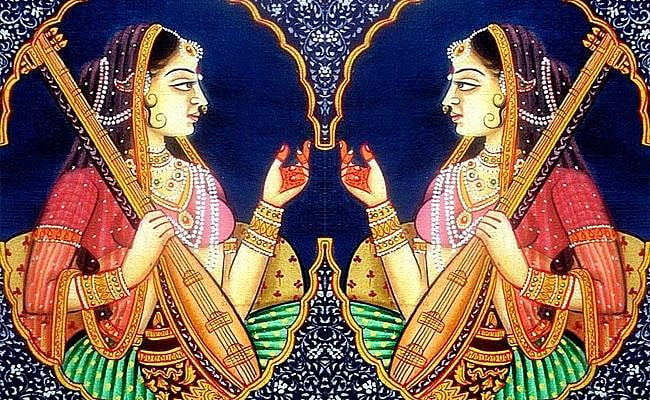
Women Sufi poets were part of a widespread emancipation movement in the Indian Subcontinent and West Asia that started more than a thousand years ago and lasted till the nineteenth century. Interestingly, these poets fought for women's rights at a time when that concept was still unformulated. This movement saw the emergence of women saints on an unprecedented scale, and was one of the most significant characteristics of the medieval age in West Asia and Southasia. Mystic women poets subverted conventional notions of gendered behaviour, helping women to defy stereotypes and break the chains of tradition and orthodoxy, which sought to control their sexuality. In the spiritual sphere of Sufism, physical distinction between male and female was often completely overlooked and the two were fused and identified. Many of the saints believed that all creation, being the product of the supreme creative power, was feminine.
Wedlock – and specifically the husband – often appears in the works of Sufi women poets as an impediment to the quest for truth, and is perceived not as a temptation but as an obstruction. It is not the husband's beauty or other allurements that must be resisted, but his interference, even tyranny. Both Lalla Arifa, also known as Lal Ded, and Mirabai walked out on their marriages. Lalla, who was a saint and mystic from Kashmir who lived in the 14th century, was married at the age of twelve to a Brahman and was badly treated by her mother-in-law. Her mother-in-law used to place a stone in her plate covered with a thin layer of food, starving the young Lalla. On the festive occasion ofgrihashanti (literally 'peace at home'), Lalla's friends teased her about the excellent food she would get to eat, to which she replied with the now famous verse: 'They may kill a big sheep or a tender lamb, Lalla will have her lump of stone all right.'
This cruel upbringing encouraged her to enter the life of an ascetic. Lalla's mother-in-law is said to have agitated her son with tales of Lalla's infidelity. In anger her husband allegedly stoned the pot that Lalla carried on her head. Though the pot broke, the water purportedly remained frozen on her head. This terrified her husband to such an extent that he could not think of retaining her as his wife. Lalla composed many songs, most of which speak of her great longing and love for Shiva. Her poems formed an important part of Kashmiri language and culture and are still revered. Indeed, there are many similarities between her life and her near contemporary Mirabai who was married to Prince Bhoj Raj of Mewar.
Some interpret Mira's marriage as part of a political alliance between the Ranas of Mewar and the Rathors of Jodhpur against the royal family of Mewar. Mira was born, according to some accounts, in 1493 and died in 1546 in a village called Kudki near Merta City in modern day Rajasthan. She is believed to have been the daughter of Ratna Singh of the Medtiya Rathor clan. Her paternal great-grandfather, Jodhaji, founded Jodhpur. Mira's bhakti, her devotional practice, first became conflicted when her husband's family attempted to remould her, as their new daughter-in-law. Many of Mira's verses refer to her ill treatment: