
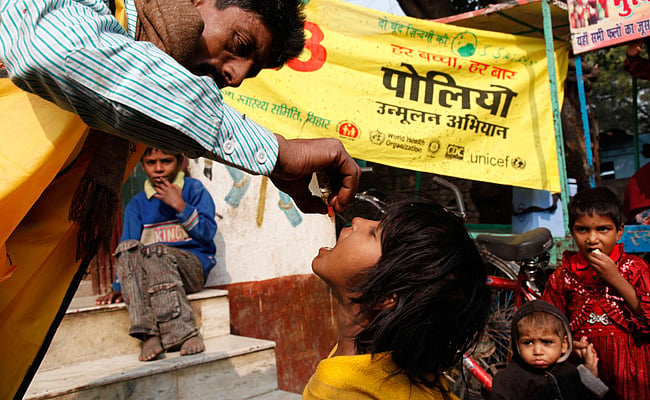
In the second decade of the 21st century, the ancient scourge of polio is endemic in only four countries; three of them are in our region. But in the global campaign to eradicate the disease, it looks as though India will be the next domino to fall. The last indigenous case of wild poliovirus in India was reported on 13 January 2011, and if another year goes by – that is, if we get to 13 January 2012 – without an additional case, the number of polio-endemic countries will officially be down to three. Further, the lessons that have been learned in tackling polio in India will be helpful in beating the disease in Afghanistan and Pakistan.
Passed from one child's belly to another's through faeces-contaminated water, polio either kills children or leaves them paralysed. Until the late 1990s, when polio eradication began in India, there were 150,000 cases a year. By 2003, transmission was occurring largely in two areas, western Uttar Pradesh and Bihar's Kosi River basin. Several factors made these last endemic regions of India extremely difficult to crack, not least because the virus unfailingly seeks out the poorest and most vulnerable children to attack. In Uttar Pradesh and Bihar, 500,000 children are born every month, and each child must be reached with polio vaccine before the virus reaches them.
Making this already complicated task more difficult, rumours have circulated, especially in the Muslim community, that polio vaccination is a plot to sterilise children, or that the vaccine contains ingredients that are haraam under Islamic law. Further, high rates of diarrhoea – due to poor hygiene and sanitation, poor nutrition, and mothers not exclusively breastfeeding for six months (and not using their first milk or colostrum) – mean that the oral polio vaccine has less opportunity to be absorbed in the gut, making it less effective. In India alone, 638 million people still practice open defecation leaving children constantly exposed to germs and bacteria. Finally, in most of the world three doses of oral polio vaccine are enough to protect a child against polio, but in UP and Bihar multiple vaccination rounds have been required to build immunity.
Casting the net
In 2002, the UN's children's agency, UNICEF, for whom both of these authors work, launched a campaign for polio eradication in India, creating a vast set of contacts called the Social Mobilization Network (commonly known as SMNet). Behind the low-tech equipment of thick paper ledgers and chalk marks on the walls and doors of homes is a cutting-edge 21st-century data-driven communications operation, which has become a model for beating the disease elsewhere.