
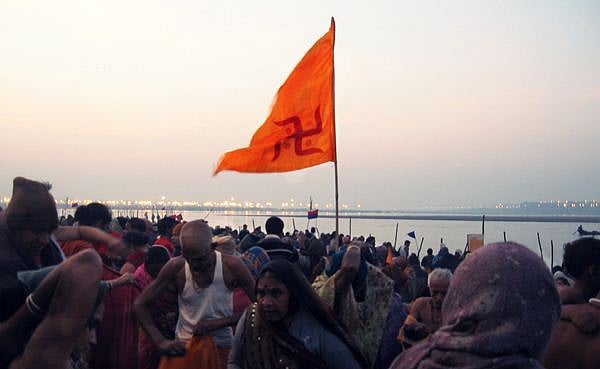
The year 2013 began in India with the culmination of a 144 year wait at the confluence of Hinduism's holiest rivers, the Ganga and Yamuna, at the city of Allahabad, also known as Prayag. The Maha Kumbh Mela had millions of devotees, tourists and academics flocking to the holy confluence over a span of two months. By the end of this massive fair, Prayag had borne the footprints of about a hundred million people – a number five times the population of Mumbai, itself one of the world's most populous cities.
The Kumbh Mela, occurring every three years, has long been considered the largest congregation of humans on the planet. The Ardh Kumbh happens every six years, the Purna Kumbh every twelve, and the Maha Kumbh – the 'Great Kumbh' – occurs only once every 144 years, or every twelfth Purna Kumbh. There are references to this festival in the Vedas and Puranas, in epics like the Mahabharata and Ramayana, and in various Tantric texts. Although not known as the Kumbh back then, under various other names the festival also finds its way into the historical accounts of Megasthenes, the Greek ambassador to the Mauryan court in the 4th century BCE, and into the Chinese traveller Xuanzang's narratives on India in the 7th century CE.
Mythology and science may appear diametrically opposed to many, but at the Kumbh these two systems of knowledge intermesh seamlessly in the popular imagination. As Prayag becomes the most crowded place on earth, astrophysics and legend overlap to inspire this epic act of faith. The Mela's mythological genesis lies in the story of the Samudra Manthan – the churning of the ocean of milk – which was a battle between the gods and demons over a pot of divine nectar; the word 'kumbh' is Sanskrit for 'pot'. To cut a long story short, after a protracted battle, the gods took possession of the nectar and handed it over to Jayant, son of Lord Indra, who escaped with it by transforming himself into a sparrow and flying away, chased by the demons. This chase lasted twelve years, during which Jupiter guided Jayant and protected him from the demons, the moon – helped prevent the nectar from spilling, the sun prevented the kumbh from breaking, and Saturn prevented Jayant from drinking all the nectar himself. Only four drops fell on earth, wherever Jayant rested –at Prayag, Haridwar, Ujjain and Nasik. Every twelve years, with Jupiter completing of a full orbit around the sun, this nectar is believed to re-appear in one of these four places at a time, corresponding to the astrological positions that Jupiter, the sun and the moon occupied when each drop was spilt.
The Vedic sciences are central to this story. The science of astrophysics is vital to the timing of the festival, which requires a precise understanding of the positions of the sun, the moon, and Jupiter. When these three bodies are placed in a particular manner vis-à-vis the Earth, its electromagnetic field is said to be enhanced. Devotees believe that the effect is especially pronounced at the four places where the nectar fell. This enhanced electromagnetic field is supposed to be favourable for the entire bio-system, and specifically for the air and water of the places where the field is most pronounced. The impact of this on humans is said to be on physical, intellectual and spiritual levels – on the nervous, respiratory, endocrine and circulatory systems. Various scientific institutions are currently investigating the healing benefits of electromagnetic fields, and several say their findings confirm some postulates of Vedic science which, as in the case of Vastushastra, the Vedic study of architecture, places much emphasis on the Earth's magnetic and other energy fields. In the Vedic world, and so at the Kumbh, science and religion were under the same umbrella and so religious vocabulary – often metaphorical, spiritual, hyperbolic, and mythological – was employed to articulate scientific concepts as well. So the nectar, and the idea that it reappeared during the festival, could be an emblem of the Vedic knowledge of electromagnetic fields.