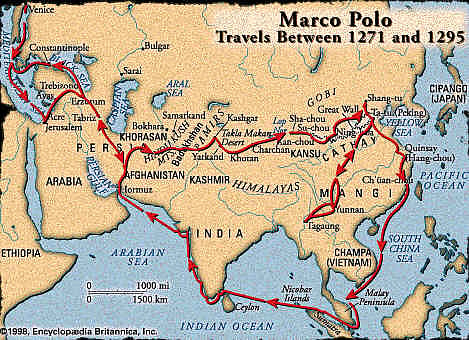
Returning home from China in 1292, Marco Polo arrives on the Coromandel Coast of India in a typical merchant ship, with over 60 cabins and some 300 crewmen. He enters the kingdom of the Tamil Pandya near modern-day Tanjore (on the coast south of Chennai), where, according to custom, "the king and his barons and everyone else all sit on the earth." He asks the king why they "Do not seat themselves more honorably." The king replies, "To sit on the earth is honorable enough, because we were made from the earth and to the earth we must return." Marco documented this episode in his famous book, The Travels, along with a rich social portrait of 13th-century India that still resonates today.
What kind of a man was Marco Polo? Raised in the cosmopolitan and mercantile city-state of Venice, Marco embraced something of its spirit, and certainly brought a merchant's pragmatic eye to bear on the world. His father and uncle – both enterprising Venetian merchants, who accompanied him on his famous journey but left no records of their own – were early role models. When Marco Polo began this journey, he was only 17. He returned in his late 30s and, a few years later, in 1298, he teamed up with a romance writer, Rustichello of Pisa, to tell his story – a vast panorama of nations largely unknown to his fellow Venetians.
As borne out by his writings, Marco was supremely inquisitive, attentive to a region's geography and natural resources, birds and beasts, climate and flora, foods and drinks. He was also drawn to the local arts and crafts, and assessed their commercial value for fellow Venetians. In Marco's day, travellers from the West classified cultures primarily by religion. As such, when arriving in a new place, he described the locals simply as Christians, Jews, Saracens (Muslims) or idolaters, the latter a catchall term for Tartars, Buddhists, Hindus, Jains and others. He admired hardworking, law-abiding people, and criticised communities he perceived to be indolent or unruly. Although there are almost no personal incidents included in The Travels, what makes his account worthwhile are his vignettes of social life: how the tartars pitch their tents or go to war, how some Central Asians extract musk from gazelles, how a girl's virginity in Cathay (China) is verified before marriage, why men in a Tibetan province prefer to take as wives women with significant sexual experience, or how the Great Khan's "admirably contrived" postal service works.