
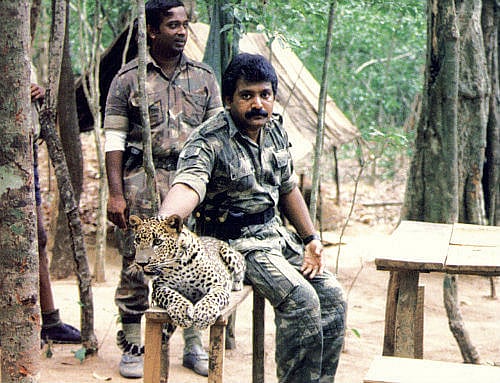
"Those who bear arms acquire and wield an extreme measure of power. We believe that if this power is abused, it will inevitably lead to dictatorship."
– Prabhakaran, from an interview with N Ram, 1986
The LTTE's supreme leader and commander, Velupillai Prabhakaran, along with his wife, children and the entire leadership of the LTTE, have been completely wiped out by the Sri Lankan military. The LTTE began as a guerrilla unit during the 1970s; at its peak, it controlled vast territory and built up a conventional army consisting of an army, navy and air force. The group won many battles against the Sri Lankan Army, crushed all Tamil opposition groups functioning in Sri Lanka, and was seen as a deadly, brutal and disciplined organisation. In recent years, however, the myth of the rebels' invincibility began to crumble, and within two years they were cornered into a small area, where they were brutally eliminated by the Sri Lankan armed forces.
Since the LTTE came into existence in 1976, more than 27,000 of its members have perished. The brutal war resulted in the loss of tens of thousands of civilian lives, and hundreds of thousands more displaced. Many civilians were disabled due to bombing and shelling. Although I blame the LTTE leadership for their suicidal politics, militarism and intolerance of criticism, I believe that the root cause of the problem was the Sri Lankan state's failure to accommodate minorities within the democratic constitutional framework of Sri Lanka. The LTTE was a by-product of the majoritarian political landscape of Sri Lanka. However, the internal dynamics within the LTTE later developed as an authoritarian structure, and loyalty to the leader was the foremost precondition. The leader and the organisation had become synonymous.
Prabhakaran was not a natural born killer with evil qualities. It was the social and political conditions that created a hierarchical organisation and, in that juncture, Prabhakaran took a lead role. Yet in this process, he became a charismatic leader and a cult figure, and this in turn changed his personality. He began to believe that he was the supreme controller of the entire Tamil population, and had the right to punish or kill those who disobeyed his orders. He was there to decide what was right and wrong, what was good and evil. He was there to liberate the Tamil nation – and he would carry out his duty until the nation was liberated. All those who opposed his methods, meanwhile, he believed should be eliminated. It was this mindset that led to the escalation and continuation of the nightmare of civil war and untold suffering for a people and a country.