
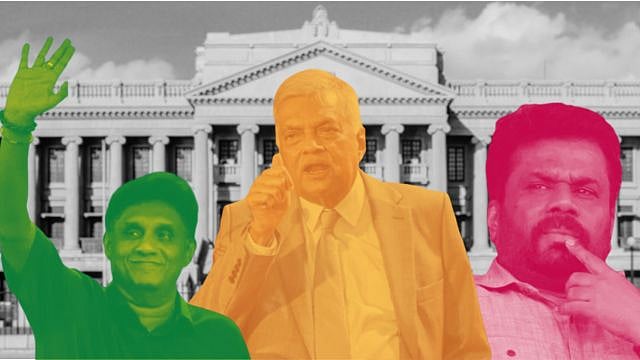
As Sri Lankans prepare to elect a new president, with voting on 21 September, the political landscape is more crowded and competitive than ever. Astrologers, who in past elections would typically appear on national television to make predictions, are conspicuously absent this time around – perhaps because a few lawmakers have argued that such predictions violate election laws, perhaps because few want to stick their necks out given the current electoral landscape. A record 38 candidates will be on the ballot, but only a few have a realistic chance of becoming Sri Lanka’s new president. The country’s presidential elections have historically been two-horse races, but the 2024 election looks to be one of the most open and unpredictable to date.
The contest is intense among the three leading candidates: the incumbent president, Ranil Wickremesinghe; Anura Kumara Dissanayake of the left-leaning National People’s Power (NPP) coalition; and the current opposition leader, Sajith Premadasa, from the Samagi Jana Balawegaya (SJB). Another contender is Namal Rajapaksa, the son of former president Mahinda Rajapaksa from the Sri Lanka Podujana Peramuna (SLPP). But the possibility of another Rajapaksa ascending to the presidency appears slim after mass protests in 2022 led to the ouster of Namal’s uncle Gotabaya Rajapaksa. With more candidates in the fray, many pundits predict that no single candidate will secure the minimum 50-percent majority vote required to clinch the presidency. In this scenario, the possibility of an unprecedented count of preferential votes to determine the winner looms large, adding another layer of uncertainty.
The contenders
Wickremesinghe’s campaign, titled “Puluwan Sri Lanka” or “Sri Lanka Can”, is gaining momentum. He is contesting as an independent candidate and his message is unmistakably consistent: he stepped forward when Sri Lanka was in crisis after the exit of Gotabaya in 2022, and managed to restore economic and political stability. Indeed, the long lines for fuel, milk powder, gas and other essentials that were a hallmark of the 2022 crisis have disappeared, and economic activity is again on the rise. The country’s foreign exchange reserves have also seen a significant boost, thanks to a bailout package agreed with the International Monetary Fund (IMF), record-breaking tourist arrivals in 2024 and increased remittances from Sri Lankans working abroad. Wickremesinghe’s chosen electoral symbol is a gas cylinder – a reminder of the queues and shortages of 2022.